

Forex trading means the buying and selling of currency pairs. You are basically buying one currency while selling another in the hopes of closing the position later with a profit.
There are a lot of forex trading strategies, but most of them are short term in nature: most are closed within a few days or weeks at most, but daytrading (the opening and closing of positions within the same day) is also common.
Unlike stocks, which many investors hold for longer periods and expect a big payday when they finally sell, forex traders usually go for many “small wins” instead of a home run. Many traders use leverage to multiply their returns, but you shouldn’t overdo it. As this article focuses on forex trading for beginners, we’d advise you to use minimal (or no) leverage in the beginning.
The most traded currency pair on the forex markets is the EUR/USD. Other major pairs include USD/JPY, GBP/USD, USD/CHF, USD/CAD and AUD/USD.
It’s good to know that there’s a difference between currency conversion and forex trading.
The end result of a conversion is basically exchanging one currency for another. Let’s say you converted your euros to pound sterling. At the beginning of the transaction you had euros and at the end, you will have pounds. Whereas, if you were trading the GBP/EUR forex pair say in a USD-denominated brokerage account, you’d book profits or losses generated by your prediction in this pair in your account currency (USD). You never actually had pounds or euros sitting in your account, just some exposure to their price action.
As you can see, forex trading always involves selling one currency in order to buy another, which is why it is quoted in pairs. Let’s take the example of the EUR/USD – here the base currency is the euro and the so-called quote currency is the US dollar. The price of a forex pair is essentially how much one unit of the base currency is worth in the quote currency.
To trade currencies, retail investors usually use the apps (or desktop platforms) of forex brokers. MetaTrader (MT) is a platform used by many brokers as it is quite intuitive for learning how to trade forex. It lacks some advanced features, but its simplicity makes it a good place to start forex trading for beginners. In fact, you’ll find brokers using the MT4 and MT5 platforms in our guide to the highest-rated forex brokers.
Basically, this would be your expectation on the direction of price movements. If you ‘go long’, you are expecting a price increase, and you will receive gains if the base currency strengthens against the quote currency.
If the current EUR/USD exchange rate is 1.21 and you expect the euro to strengthen against the US dollar, you could go long on this pair. A short-term trader might aim for a target of 1.215 while somebody expecting a big decline in the dollar against the euro could have a more ambitious target of say 1.25.
Conversely, if somebody is selling this contract (or in other words, is ‘going short’) it means they would profit from the euro weakening against the greenback.
Not sure how this works? We show an imaginary trade in our article Forex trading examples with profit and loss calculations.
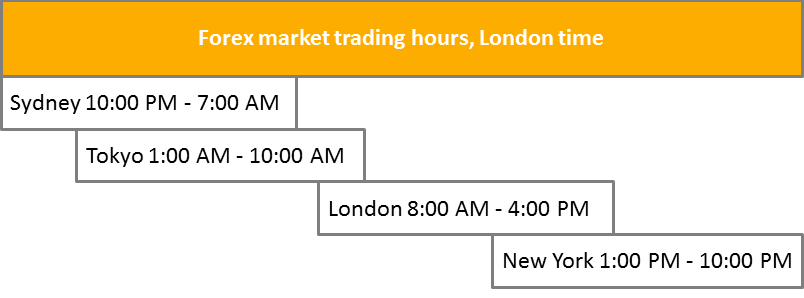
The vast majority of currency transactions are conducted on so-called OTC (over-the-counter) markets. The forex market is open continuously from 11:00 PM Sunday until 11:00 PM Friday, London time, in different parts of the world.
Now, let’s dive into a few commonly used terms to help you understand forex lingo.
The bid in the example image above is the price at which you can sell the EURUSD or, in other words, to go short in it. If the price goes lower, you will generate a profit. The ask price is the price you’d need to pay to go long in this pair.
So, to recap: a long position is when you bet on a price increase, while a short position is when you profit from a price decrease.
The spread is the difference between the ask and bid price. In the example above the spread is calculated as 1.1705-1.1700, so 0.0005.
A ‘lot’ in forex trading is a measure of unit for the size of the trade contract.
One standard lot has 100,000 units of the base currency, a mini lot has 10,000 and a micro lot has 1,000 units.
For example, if you buy 1 standard lot of EUR/USD at 1.25, you are buying 100,000 euros and selling 125,000 US dollars.
When you sell 1 micro lot of EUR/JPY at 130, you are selling 1,000 euros and buying 130,000 yen.
Leverage allows you to take bigger positions than the amount of money on your account. Imagine this as something that can multiply your profits, but also your losses.
Let’s see an example! Imagine you have $1,000 on your account and your applied leverage is 100:1. If you open a long position by using all your $1,000, this means you are opening a trade in the value of $100,000. If the price decreases 1%, you will lose $1,000 (1%*$100,000), that is, all of the money on your account. And it is quite normal for the price of a currency pair to decrease by 1% – in the case of EURUSD, this would mean a price decrease from 1.1705 to 1.1588, for example. However, if the price goes up 1%, your winnings are $1,000, meaning you doubled your money. So it is a high risk action – the bigger the leverage, the higher the risk. That is the reason why we do not recommend using too high leverage. In fact, regulators in the EU and Australia only allow leverage up to 30:1 for major currency pairs for brokers registered in those jurisdictions.
A financing rate (or overnight rate) is charged when you hold a leveraged position for more than a day (also called a rollover fee). It is calculated from the interest rate difference between the two currencies you are trading. Instead of a debit, you receive a credit from the broker if the interest rates you trade are in your favor.
In general, it can be said that liquidity and market flows dictate short-term price movements on currency markets, while economic fundamentals shape longer-term trends.
On the fundamental level, the economic data of individual countries like inflation rates and the monetary response to them (like interest rate movements by central banks) are crucial to understand exchange rate moves. Global events like wars or pandemics can also have a huge impact.
See a practical breakdown on how to use this in our forex trading examples, see some of the top forex trading strategies or check our guide on how to start forex trading. You can also learn industry terms using our forex trading glossary.

Compare broker tool
Compare selected brokers by their fees, minimum deposit, withdrawal, account opening and other areas. Filter according to broker or product type, including stocks, futures, CFDs or crypto.
Not sure which broker to choose?
For a tailored recommendation, check out our broker finder tool. Answer 4 simple questions and get a list of the most relevant brokers. & FMB button.
Compare broker tool
Compare selected brokers by their fees, minimum deposit, withdrawal, account opening and other areas. Filter according to broker or product type, including stocks, futures, CFDs or crypto.