


Below is an overview of how analysts from a global brokerage comparison platform view the current landscape of the online retail trading industry and the major trends expected to influence markets in 2022.
Retail investors remain a powerful force in the market.
A large wave of beginner investors entered financial markets over the past year, and many of them appear to be staying active participants.
Industry growth has slowed but remains strong.
By the end of 2021, the brokerage sector began returning to activity levels closer to those seen before the pandemic. Even so, many online brokers continue to report solid revenues and profitability.
Retail traders will continue to drive market activity.
Although the pace of new account openings is beginning to decline, individual investors are still expected to remain a major source of trading volume.
Cryptocurrency remains a central theme.
Digital assets are likely to stay highly popular among investors throughout 2022. At the same time, increasing regulatory oversight is expected as governments and regulators respond to the rapid growth of the crypto market.
Macroeconomic risks may shape trading opportunities.
Retail traders are expected to remain active during the year, especially as global economic factors—such as rising interest rates, inflation pressures, increasing energy costs, new COVID variants, and concerns about China’s real estate sector—create both uncertainty and potential trading opportunities.
According to our analysts at TradingBrokersView, these were the most important trends in 2021:
The online brokerage industry experienced a noticeable slowdown during the second half of 2021 compared with the surge seen earlier in the year. Data shows that new account openings among brokers included in the analysis declined sharply, dropping 73% in the third quarter compared with the first quarter of 2021.
Despite the decrease in new users, CFD and stock brokers—which typically generate the highest levels of trading activity—continue to dominate the sector and remain the most effective at generating revenue.
Overall, brokers included in the analysis recorded around 30% higher revenue and profit between the first and third quarters of 2021 compared with the same period the year before. However, there are significant differences between firms when it comes to how effectively they monetize their user base, particularly in terms of revenue generated per customer. Some platforms perform much better than others in this area, while brokers such as Robinhood rank among the weakest in terms of revenue per client.
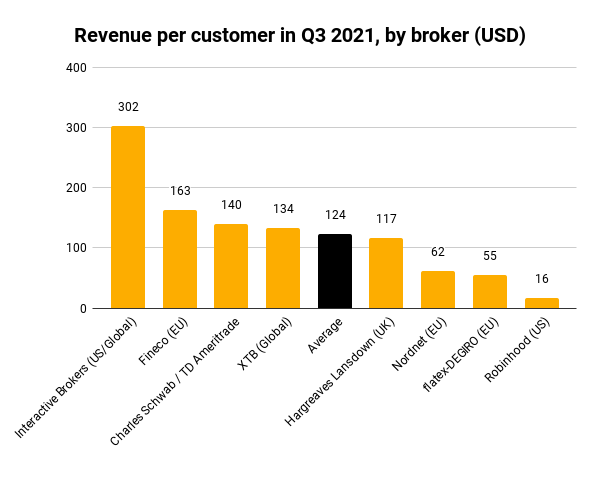
Revenue per customer in Q3 2021, by broker (USD)
Between 2015 and 2021, assets under management (AUM) at brokers included in the analysis grew at a compound annual growth rate of approximately 28%. The most notable increase occurred between 2019 and 2020, when the total value of managed assets rose sharply.
One of the key factors behind this expansion has been the surge in retail investor participation. Brokers in the United States dominate the market in terms of scale, holding more than 20 times the assets under management compared with other brokers included in the analysis. They also maintain significantly more customer accounts overall. Account sizes vary widely across platforms; for instance, the typical Robinhood account holds around $4,000, while the average account at Fidelity is roughly 70 times larger.
Despite the overall growth in assets, the pace of new account openings slowed considerably during 2021. Among brokers covered in the analysis, new accounts in the third quarter of 2021 were 73% lower than in the first quarter of the same year.
One of the most pronounced declines occurred at Robinhood, where new account creation dropped by 88%. Earlier in the year, market expansion had been largely driven by the United States, with American brokers leading in the total number of brokerage accounts. In fact, US brokers collectively hold about nine times as many accounts as the other brokers included in the analysis.
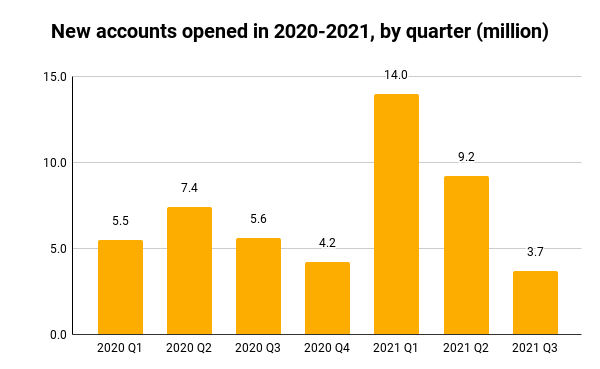
New accounts opened in 2020-2021, by quarter (million)
The number of executed trades spiked in the first quarter of 2021: activity in this quarter was 51% higher than the average for the period between Q1 2020 and Q3 2021. There are roughly 15 times more trades at US brokers than at other brokers covered in our analysis. One of the main reasons behind this is their significantly higher customer base. There are significant differences between the trading activity of customers at various brokers: for example, traders at Interactive Brokers or XTB trade up to 5-10 times more than clients at other brokers.
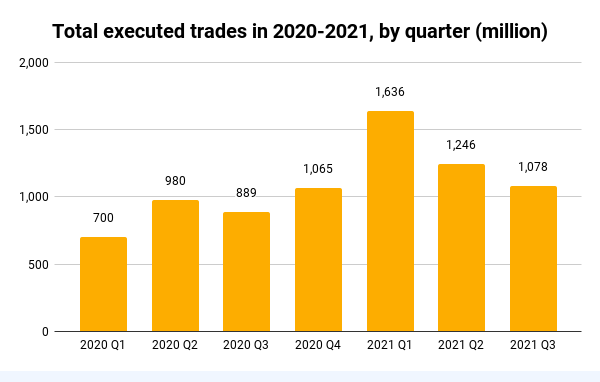
Total executed trades in 2020-2021, by quarter (million)
More detailed statistics about the global retail brokerage industry can be explored through a dedicated data dashboard, which provides additional insights into investor behavior and market activity.
Data shows that many first-time investors who entered the markets during the pandemic-driven surge remain active today. Beginner traders still represent a large share of market participants. The proportion of newcomers appears to be higher in the United States, although the overall number of retail investors is roughly similar between the US and the European Union.
Trading behavior also differs between the two regions. Day trading and options trading are significantly more popular in the US than in Europe, continuing a pattern that was already visible in previous years. In terms of preferred investment products, stocks and ETFs remain the most sought-after assets, while cryptocurrencies have gained substantial popularity.
Interest in crypto assets has increased considerably. Around 9% of visitors say cryptocurrencies are the primary asset they are interested in, compared with less than 5% the previous year, indicating that demand for digital assets has nearly doubled.
During the dramatic market events surrounding GameStop, regulators, brokers, and investors observed how retail trading activity could influence broader markets. One of the most notable developments has been the growing impact of the options market.
As large numbers of individual investors entered options trading during the pandemic, derivatives activity has increasingly influenced the behavior of the broader stock market. In many cases, options trading can drive price movements in underlying stocks.
This phenomenon is often described as “the tail wagging the dog.” Because options require less capital than buying shares directly, investors can control a much larger exposure to a stock with a smaller investment. This leverage makes the options market particularly powerful.
For brokerage firms, the trend is also financially beneficial. While many brokers offer commission-free trading for stocks, they typically still charge fees for options transactions, making derivatives trading an important revenue source for the industry.
At TradingBrokersView, we believe the following were the biggest stories of 2021 in trading:
In early 2021, a large wave of retail investors challenged major institutional players in a market event that captured global attention. The GameStop surge began when users on a Reddit forum coordinated buying activity to counter the heavy short positions held by hedge funds against the company’s stock. Believing the stock was undervalued, many participants began purchasing call options and building long positions.
As more traders joined the movement, GameStop’s share price soared dramatically. The rapid rise attracted widespread media coverage and sparked a surge of new retail trading accounts. The sudden influx of users put pressure on several brokerage platforms, and some—such as Robinhood—temporarily restricted trading in certain securities. This decision triggered strong criticism from retail investors and drew increased scrutiny from regulators.
Retail traders played a major role in driving new account openings during the pandemic period, although the pace of new accounts began to slow in the second half of the year.
The GameStop short squeeze and the increasing “gamification” of trading highlighted one of the defining market phenomena of 2021: meme stocks. These are companies whose shares rapidly gain popularity among retail investors through social media platforms and online communities such as Reddit.
The sudden surge in attention often leads to extremely high trading volumes and sharp price increases that may have little connection to the company’s underlying fundamentals. Instead, the momentum is frequently driven by online enthusiasm and speculative activity that can resemble gambling more than traditional investing.
Robinhood’s initial public offering was among the most anticipated stock market events of 2021. The listing followed closely after the GameStop controversy and occurred while regulators were closely examining the company’s business model.
Data analysis shows that Robinhood’s user base is approximately three times larger than that of other brokers included in the survey. In addition, the platform’s customer growth rate has been more than three times faster than the average growth rate of competing brokers.
However, the typical Robinhood account holds 40–50 times less capital than accounts at many traditional brokerage firms. Despite the smaller account balances, client assets have been growing rapidly, and Robinhood’s revenue growth has outpaced the industry average by more than threefold.
A key component of Robinhood’s business model is payment for order flow (PFOF), where market makers pay brokers for directing trade orders to them. This arrangement has drawn regulatory attention because a large share of trading volume may be concentrated among a small number of firms, potentially increasing their influence over market activity.
Brokerage firms are expected to operate transparently and fairly, but regulatory penalties have been imposed when standards are not met. In 2021, Robinhood received a $70 million fine from the Financial Industry Regulatory Authority (FINRA)—the largest penalty ever issued by the organization—for causing widespread harm to customers through misleading information about investments.
Looking at the past twenty years, the second-largest fine in the brokerage sector was $52 million, paid by Ally Invest in 2016 to the US Department of Justice after its subsidiaries improperly sold subprime mortgage-backed securities. The third-largest penalty was $48 million, imposed on CITIC Securities in 2017 as part of regulatory action following China’s 2015 stock market crisis.
Analysis of industry data indicates that about 30% of brokers have faced regulatory fines at some point. Although these penalties may appear smaller than those imposed on major banks, they can still represent a significant financial burden for brokerage firms, which are typically smaller organizations.
With the rise of mobile trading apps and zero-commission brokerage platforms, it is interesting to examine who is actually participating in the retail investment boom.
Data shows that the retail trading community is predominantly male, with men accounting for 76% of investors globally, compared with 24% female participation. However, the gender gap varies across countries. For example, the Philippines has the highest proportion of female investors, where women represent about 44% of the investor base.
Age demographics reveal that the largest group of investors—around 39%—are between 25 and 34 years old, while only about 5% are aged 65 or older.
In terms of technology preferences, investors are almost evenly split between desktop and mobile trading. Approximately 49.1% use desktop computers, 48.8% trade through smartphones, and 2.1% access trading platforms using tablets.
Our analysts at TradingBrokersView think these are the trends to watch in online trading in 2022:
Several macroeconomic developments are expected to shape financial markets in 2022. Analysts point to rising global inflation, increasing energy prices, and concerns surrounding China’s property sector as key factors to monitor.
Central banks are also shifting policy. The US Federal Reserve may complete its asset-purchase tapering before mid-year, while both the Fed and the European Central Bank are widely expected to begin raising interest rates before the end of the year. At the same time, markets have been closely watching China’s heavily indebted property developer Evergrande, which has struggled to manage more than $300 billion in liabilities. Households around the world are also facing sharply higher energy costs.
According to analysts, persistent inflationary pressure makes higher interest rates increasingly likely. Additionally, new COVID variants—such as Omicron—may trigger periods of elevated volatility in global markets.
Market activity has cooled from the extreme levels seen during pandemic lockdowns. Many of the new investors who entered the market during that period tend to follow strong trends and trade actively during periods of excitement, while remaining inactive when markets become calmer. This behavior could leave some inexperienced traders holding positions that may prove difficult to manage over the long term.
If interest rates rise, brokerage firms may benefit financially because they can earn more interest on the uninvested cash held in client accounts. Analysts expect retail trading activity to remain relatively strong, as uncertainty surrounding inflation and central bank policies may produce periodic market swings that traders can attempt to exploit.
Retail traders may increasingly turn to put options in 2022. Instead of betting on rising prices through call options, traders may use puts to profit from declining markets or hedge against downside risk.
This shift could become more visible if certain sectors—such as technology stocks or high-growth funds like ARKK—experience sustained downtrends. Momentum trading strategies can move in either direction depending on market sentiment.
The largest and most established brokers are expected to maintain their dominant positions in the market. Although new competitors continue to emerge, the strongest platforms remain difficult to challenge.
Among the leading brokers, Interactive Brokers continues to rank among the top overall platforms. Saxo Bank remains highly regarded in forex trading, while DEGIRO stands out among discount brokers. eToro continues to be one of the most prominent platforms for cryptocurrency trading.
Following the public listings of companies such as Robinhood and Coinbase, other firms are also considering entering public markets. Many online brokers are evolving beyond simple trading platforms and are aiming to become comprehensive financial hubs, offering services such as cash management, interest-earning accounts, and integrated spending tools.
The trend toward zero-commission trading is expected to continue. Many brokers rely on alternative revenue streams such as payment for order flow (PFOF), a common model in the United States where market makers compensate brokers for directing orders to them.
Although regulators in the US and Europe are examining the practice more closely, major rule changes are unlikely to take effect immediately. In Europe, discussions about restricting or banning the model are ongoing but could take years before any regulations are implemented.
In some cases, commission-free trading is primarily used as a strategy to attract new customers, who may later trade higher-margin products such as CFDs. In other cases, brokers offset the absence of commissions through other costs, such as currency conversion fees.
Interest in cryptocurrency trading continues to grow rapidly. As demand from investors increases, more brokerage platforms are adding digital asset trading to their offerings.
The two largest cryptocurrencies, Bitcoin and Ethereum, reached new record highs during the year, while several altcoins also experienced dramatic price surges. For example, Shiba Inu rose by more than 2.4 million percent, Dogecoin climbed nearly 9,600 percent, and Terra increased by over 6,400 percent during peak periods.
Analysts note that growth in crypto trading activity has been even faster than the expansion of equity trading among many investors. However, greater regulatory oversight appears likely as governments attempt to address transparency, investor protection, and environmental concerns.
Some countries have already taken strong action. China declared cryptocurrency transactions illegal, while policymakers in Sweden urged the European Union to restrict crypto mining due to its environmental impact.
Alongside cryptocurrencies, non-fungible tokens (NFTs) are also expected to remain a rapidly expanding segment of the digital asset market, as interest in blockchain-based ownership and collectibles continues to grow globally.
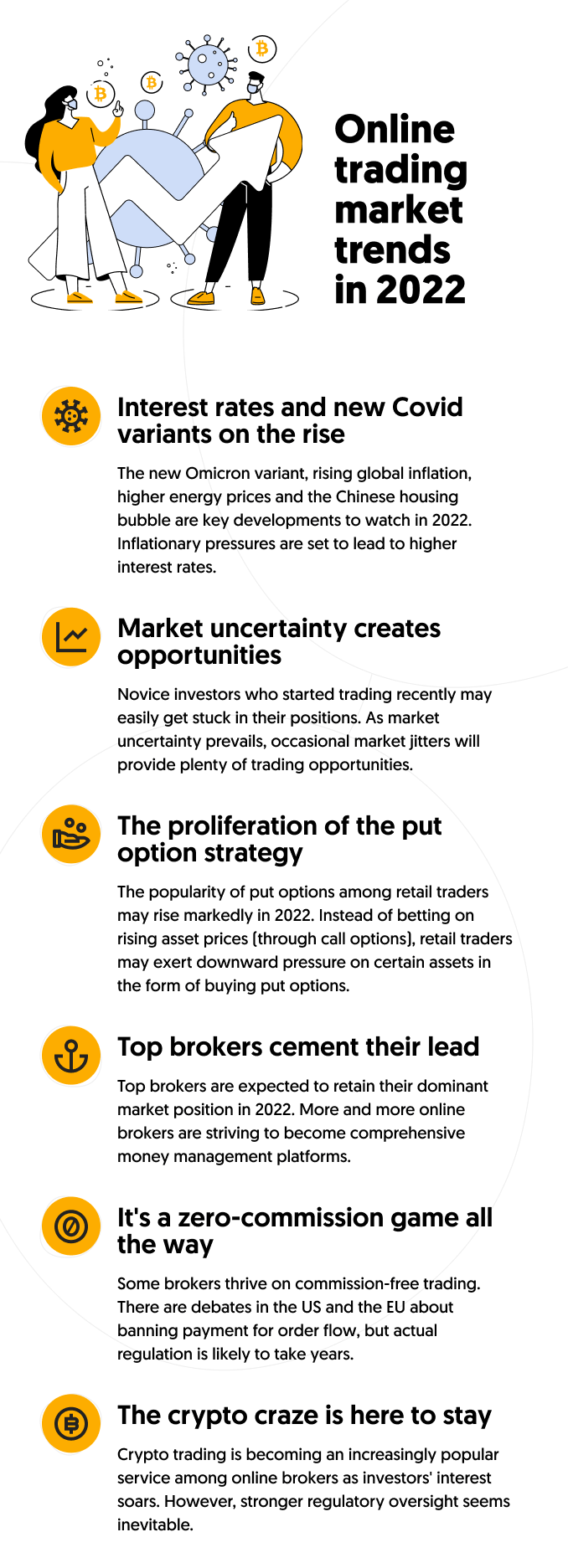
Online trading market trends in 2022

Compare broker tool
Compare selected brokers by their fees, minimum deposit, withdrawal, account opening and other areas. Filter according to broker or product type, including stocks, futures, CFDs or crypto.
Not sure which broker to choose?
For a tailored recommendation, check out our broker finder tool. Answer 4 simple questions and get a list of the most relevant brokers. & FMB button.
Compare broker tool
Compare selected brokers by their fees, minimum deposit, withdrawal, account opening and other areas. Filter according to broker or product type, including stocks, futures, CFDs or crypto.