

You can be sure that eToro is not a scam, as we tested it with a live account and had no trouble accessing our funds. In case of any major problems, you may be eligible for state-mandated investor protection and/or additional insurance of up to €/AUD1 million by eToro.
| Pros | Cons |
|---|---|
| • Free stock and ETF trading | • High non-trading fees |
| • Seamless account opening | • Only one account base currency |
| • Social trading | • Customer support should be improved |
| 🗺️ Country of regulation | UK, Cyprus, Australia |
| 💰 Trading fees class | Low |
| 💰 Inactivity fee charged | Yes |
| 💰 Withdrawal fee amount | $5 |
| 💰 Minimum deposit | $50 |
| 🕖 Time to open an account | 1 day |
| 💳 Deposit with bank card | Available |
| 👛 Depositing with electronic wallet | Available |
| 💱 Number of base currencies supported | 1 |
| 🎮 Demo account provided |
79% of retail CFD accounts lose money |
| 🛍️ Products offered | Stock, ETF, Forex, Options, CFD, Crypto |
🆕 If you’re a first-time investor, we’re here to help you buy your first stock!
Follow our new step-by-step guide , including screenshots and hands-on tips, and you’ll have no trouble purchasing your first stocks by yourself!
eToro offers free stock, ETF and options trading, while forex and CFD fees are low. On the negative side, non-trading fees are high, including a $5 withdrawal fee.
| Pros | Cons |
|---|---|
| • Low trading fees | • Inactivity fee |
| • Free stock and ETF trading | • $5 withdrawal fee |
| • Low forex and CFD fees |
| Assets | Fee level | Fee terms |
|---|---|---|
| S&P 500 CFD | Low | The fees are built into the spread, 0.75 points is the average spread cost during peak trading hours. |
| Europe 50 CFD | Average | The fees are built into the spread, 3 points is the average spread cost during peak trading hours. |
| EURUSD | Low | The fees are built into the spread, 1 pip is the average spread cost during peak trading hours. |
| Inactivity fee | Low | $10 per month after one year inactivity. Inactivity means that you don’t log in to your account |
We ranked eToro’s fee levels as low, average or high based on how they compare to those of all reviewed brokers.
First, let’s go over some basic terms related to broker fees. What you need to keep an eye on are trading fees and non-trading fees.
In the sections below, you will find the most relevant fees of eToro for each asset class. For example, in the case of forex and stock index trading the most important fees are spreads, commissions and financing rates.
We also compared eToro’s fees with those of two similar brokers we selected, Trading 212 and XTB. This selection is based on objective factors such as products offered, client profile, fee structure, etc. See a more detailed rundown of eToro alternatives.
eToro has slightly different trading and non-trading fees for clients in the US, where eToro offers stock, ETF and crypto trading only – for more information, read our overview of eToro fees in the US.
To have a clear overview of eToro, let’s start with its trading fees.
Is eToro worth it? eToro trading fees are low.
We know it’s hard to compare trading fees for CFD brokers. So how did we approach the problem of making their fees clear and comparable? We compare brokers by calculating all the fees of a typical trade for selected products.
We chose popular instruments within each asset class:
A typical trade means buying a leveraged position, holding it for one week and then selling. For the volume, we chose a $2,000 position for the stock index and stock CFDs and $20,000 for the forex transactions. The leverage we used was:
These catch-all benchmark fees include spreads, commissions and financing costs for all brokers. Let’s see the verdict for eToro fees.
eToro offers zero-commission real stock trading. Since May 2020, this is valid for all countries, but for clients from Australia commission-free trading only applies to US stocks. Note that with the free feature, you’re buying the real stock, not a CFD product, and you cannot use leverage.
eToro used to be primarily a CFD broker that let you trade stocks and ETFs also in the form of CFDs, if you set the leverage to greater than one.
Trades that involve stocks not traded in USD (like UK or European stocks) will be converted to USD at the actual market prices by eToro, without taking any commission or markup. What’s more, eToro will also absorb any tax duty that might be due if you trade on the UK market.
| eToro | XTB | Trading 212 | |
|---|---|---|---|
| US stock | $0.0 | $0.0 | $0.0 |
| UK stock | $0.0 | $0.0 | $0.0 |
| German stock | $0.0 | $0.0 | $0.0 |
eToro has generally low CFD trading fees.
| eToro | Trading 212 | XTB | |
|---|---|---|---|
| S&P 500 index CFD fee | $3.1 | $1.4 | $4.0 |
| Europe 50 index CFD fee | $3.2 | $2.0 | $3.3 |
| Apple CFD fee | $6.4 | $16.5 | $10.1 |
| Vodafone CFD fee | – | $14.7 | $10.6 |
eToro forex fees are generally low.
| eToro | Trading 212 | XTB | |
|---|---|---|---|
| EURUSD benchmark fee | $15.6 | $26.7 | $17.7 |
| GBPUSD benchmark fee | $4.5 | $21.8 | $12.2 |
| AUDUSD benchmark fee | $9.6 | $16.7 | $12.1 |
| EURCHF benchmark fee | $12.5 | $16.9 | $6.1 |
| EURGBP benchmark fee | $16.4 | $25.6 | $12.6 |
eToro offers commission free option trading.
eToro charges a 1% fee per trade.
eToro has average non-trading fees, as it charges $10 per month after one year of inactivity, but simply logging into your account counts as an activity. There is also a $5 withdrawal fee.
| eToro | Trading 212 | XTB | |
|---|---|---|---|
| Account fee | No | No | No |
| Inactivity fee | Yes | No | Yes |
| Deposit fee | $0 | $0 | $0 |
| Withdrawal fee | $5 | $0 | $0 |
 eToro costs
eToro has high non-trading fees, as it charges $10 per month after one year of inactivity, but simply logging into your account counts as an activity. The withdrawal fee has been recently lowered to $5.
Account opening at eToro is seamless and very fast, and the minimum deposit is relatively low for most countries.
| Pros | Cons |
|---|---|
| • Fast | None |
| • Fully digital | |
| • Low minimum deposit |
79% of retail CFD accounts lose money
What is the minimum deposit at eToro?
The required eToro minimum deposit is $50. As a temporary measure in February 2021 during a volatile market period, eToro raised its minimum deposit requirement, but it was reinstated to the previous level on March 8, 2021.
Note however that the minimum amount for a bank transfer is $500.
However, some countries have different minimum deposit requirements:
Your first-time deposit amount at eToro is dependent on your residency and ranges from $10 to $10,000, see the table below. For most users, a $50 deposit minimum have to be taken into account.
| Users residing in: | Minimum deposit amount: |
|---|---|
| United Kingdom, United States | $10 |
| Australia, Austria, Belgium, Bulgaria, Croatia, Cyprus, Czech Republic, Denmark, Estonia, Finland, France, Greece, Guernsey, Hungary, Indonesia, Ireland, Italy, Latvia, Liechtenstein, Luxembourg, Malaysia, Malta, Monaco, Netherlands, Norway, Philippines, Poland, Portugal, Romania, Singapore, Slovakia, Slovenia, Spain, Sweden, Switzerland, Taiwan, Thailand, United Arab Emirates, Vatican City, Vietnam | $50 |
| All other eligible countries | $200 |
| Cayman Islands, French Polynesia, Gibraltar, Iceland, Isle Of Man, Jersey Island, Kuwait, Lithuania, Reunion Island | $1,000 |
| Israel | $10,000 |
eToro offers two simple account types: there is a live account, as well as a demo (or virtual) account, where you can test the platform with play money.
The account opening process is hassle-free and fully digital. It is fast too, as we were able to open an account within one day.
You have to start by registering with your email account or with your Facebook or Google account. And that’s basically it – you can immediately access the trading platform and start to trade with a $100,000 demo account.
If you want to go further and fund it with real money, you have to verify your identity and residency by uploading the required documents:
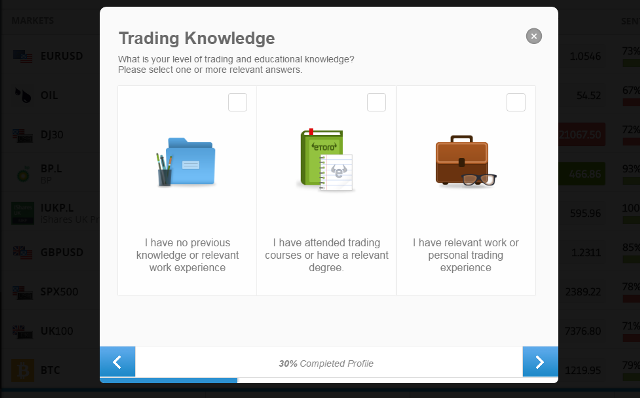
eToro review – Account opening
eToro minimum depositIn most cases the required eToro minimum deposit is $50.
The highest ranking competitors are:
Depositing money is easy, with a lot of available options, although there is a $5 withdrawal fee. As only USD accounts are available, you may pay a high conversion fee if you deposit or withdraw in another currency, like EUR or GBP.
| Pros | Cons |
|---|---|
| • Credit/Debit card available | • Only one account base currency |
| • User-friendly | • $5 withdrawal fee |
| • Conversion fee for non-USD deposits |
eToro allows only USD accounts, which means that funds in other currencies might need to be converted by eToro to USD.
For example, if you deposit EUR by bank transfer, a 50 pip conversion fee will be applied at funding (which is around 0.46% of the deposit amount) and the same fee will also be charged when you withdraw EUR by bank transfer. For other methods, like credit cards, a higher fee applies for some currencies.
Alternatively, you can deposit in USD, e.g. using your credit or debit card. In that case, your bank will make the conversion at its own exchange rate.
| eToro | Trading 212 | XTB | |
|---|---|---|---|
| Number of base currencies | 1 | 8 | 5 |
A convenient way to save on currency conversion fees is opening a multi-currency bank account at a digital bank. Digital banks offer bank accounts in several currencies with great currency exchange rates as well as free or cheap international bank transfers. Opening an account only takes a few minutes on your phone.
eToro states that you can use your Revolut account to deposit and withdraw in USD, GBP and EUR.
There are a lot of deposit options, however, not all of them are available in every country:
| eToro | Trading 212 | XTB | |
|---|---|---|---|
| Bank transfer | Yes | Yes | Yes |
| Credit/debit card | Yes | Yes | Yes |
| Electronic wallets | Yes | Yes | Yes |
For some countries, eToro may require the first deposit to be made with credit/debit card or bank transfer and only subsequent deposits can be made with electronic wallets.
A bank transfer takes 4-7 business days, and there is no maximum deposit. In comparison, while credit/debit card and electronic wallet deposits are instant, there are per transaction limits: $40,000 in the case of credit/debit cards, and either $10,000 or $30,000 (Klarna) in the case of electronic wallets.
You can only deposit money from funding sources that are in your name.
eToro charges no deposit fees, but they have currency conversion fees that might be high; for example, as much as 1.4% for depositing EUR by card. Note that a 50 pip charge is not the same percentage in AUD to USD conversion as in EUR to USD conversion, so in the table below we added an estimation of the percentage charge as well.
| USD | EUR | GBP | AUD | |
|---|---|---|---|---|
| Bank transfer | none | 50 pips, approx. 0.46% of the deposit amount | 50 pips, approx. 0.40% of the deposit amount | 50 pips, approx. 0.77% of the deposit amount |
| Other methods | none, your bank will charge for conversion if your card is not in USD | 150 pips, approx. 1.40% of the deposit amount | 50 pips, approx. 0.40% of the deposit amount | 100 pips, approx. 1.56% of the deposit amount |
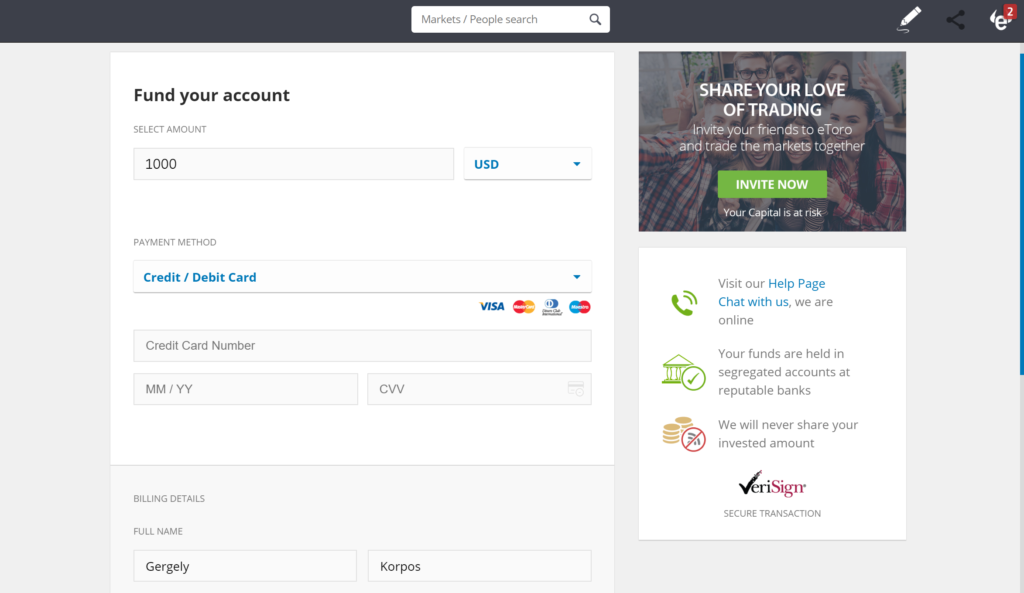
eToro review – Deposit and withdrawal – Deposit
eToro has a $5 withdrawal fee, which is high compared to other CFD brokers. In addition, eToro has a $30 minimum amount limit on withdrawals.
Withdrawal options are the same as the funding options: you can withdraw money using bank transfer, credit/debit card or electronic wallets, similar to other CFD brokers.
| eToro | Trading 212 | XTB | |
|---|---|---|---|
| Bank transfer | Yes | Yes | Yes |
| Credit/debit card | Yes | Yes | No |
| Electronic wallets | Yes | Yes | no |
| Withdrawal fee | $5 | $0 | $0 |
How long does it take to withdraw money from eToro?
We tested withdrawal by bank transfer, and it took 2 business days.
How do you withdraw money from eToro?
You can only withdraw money to accounts under your name.
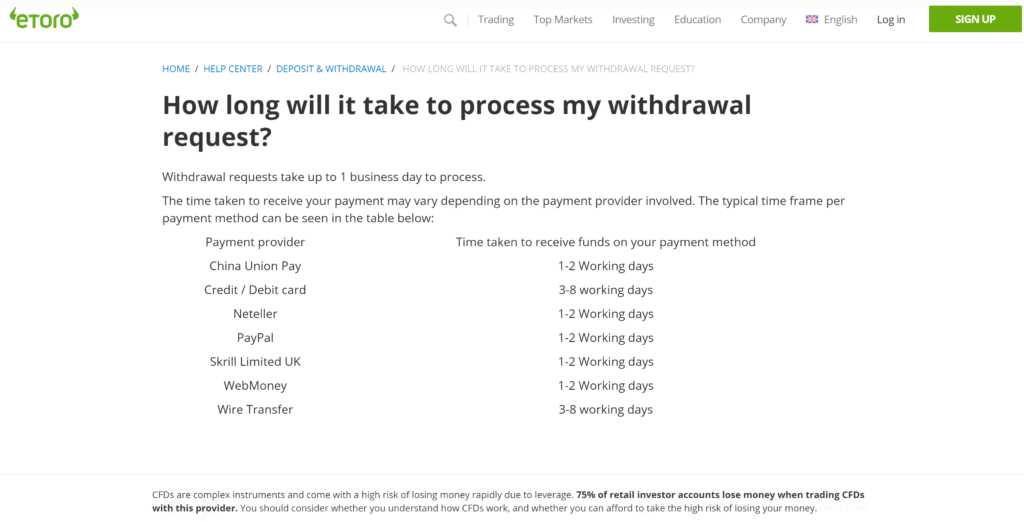
eToro review – Deposit and withdrawal – Withdrawal time
eToro has a $5 withdrawal fee, which is high, compared to other CFD brokers. In addition, eToro has a $30 minimum amount limit on withdrawals.
eToro offers a user-friendly and well-designed web trading platform, where social trading is also available. On the other hand, the platform’s customizability is limited.
| Pros | Cons |
|---|---|
| • User-friendly | • Limited customizability (for charts, workspace) |
| • Clear fee report | |
| • Two-step (safer) login |
| Trading platform | Score | Available |
|---|---|---|
| Web | 4.4 stars | Yes |
| Mobile | 4.9 stars | Yes |
| Desktop | – | No |
| Arabic | Chinese (simplified) | Chinese (traditional) | Czech | Danish |
| Dutch | English | Finnish | French | German |
| Italian | Malaysian | Norwegian | Polish | Portuguese |
| Romanian | Russian | Spanish | Swedish | Vietnamese |
| Thai |
The web trading platform has a clean design and great functions. The menus and buttons are where you expect them to be.
It is hard to customize though, as the panels are fixed. One exception is the watchlist, which is easy to configure.
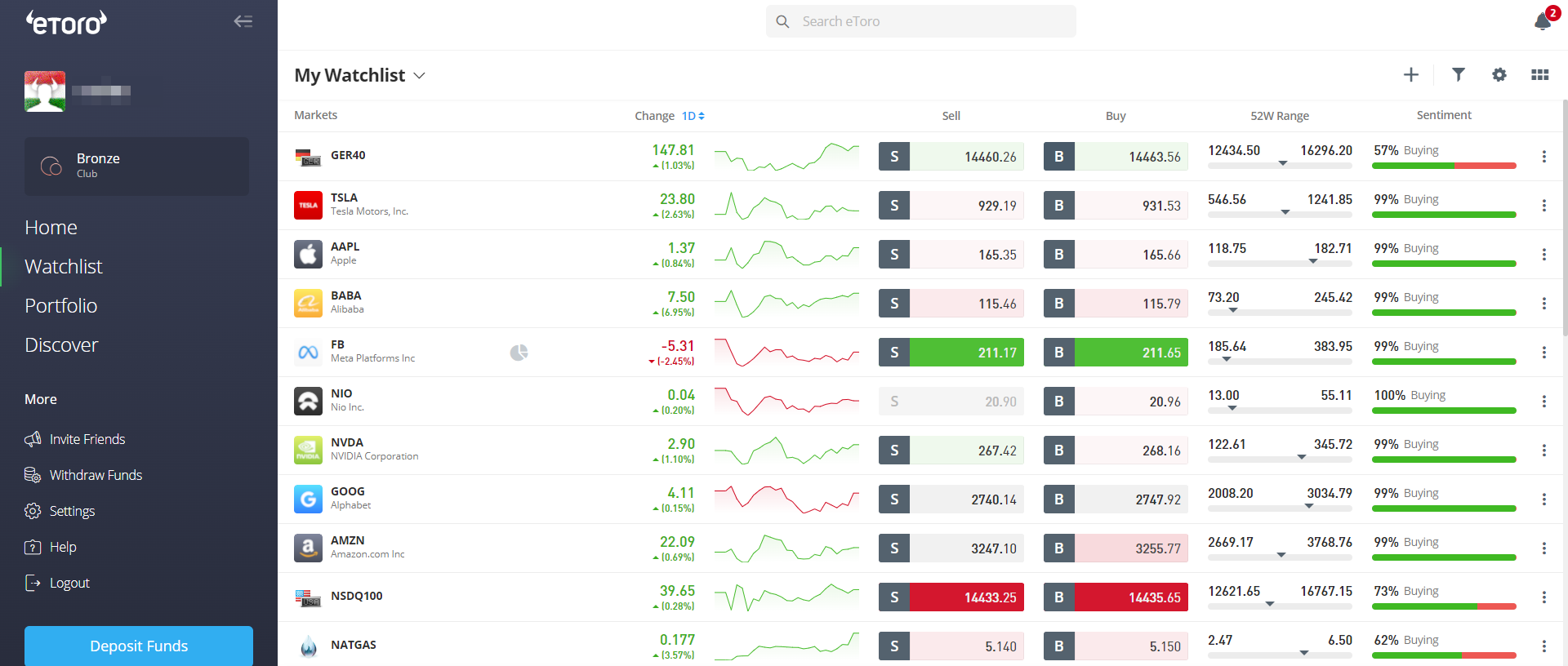
eToro review – Web trading platform
eToro has an optional, safer two-step login system. This can make it more complicated to log in, but it provides you with added security. You’ll receive a text to your phone. Unfortunately, biometric authentication is not supported.
The built-in search is predictive and easy to use. Type in a company or product name and you can see the results. You can search easily using tickers, too.
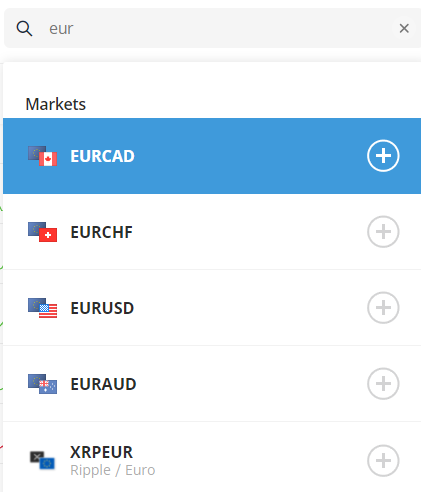
eToro review – Web trading platform – Search
Placing orders is self-explanatory. You can use the following order types: Market, Limit, Stop-loss, Trailing stop-loss.
If you are not familiar with order types, read this overview.
We found it quite strange that you cannot edit pending limit orders. For example, if you have a limit order for company X at $20 per share, you must cancel the pending order and create a new one in order to modify the order to $21 per share.
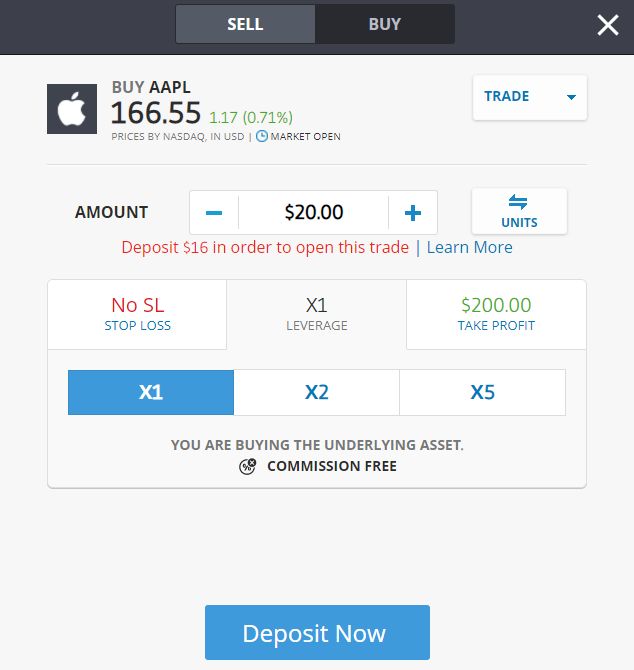
eToro review – Web trading platform – Order panel
You can set price alerts and notifications easily. eToro’s alert function lets you know when an asset reaches a price target, and you also get a notification when your order is fulfilled. On the web platform, this is in the form of an icon update or a browser notification. On mobile, it is a push notification.
You will surely want to know how your portfolio is performing and how much you paid in fees. You can decide how you want to see your portfolio reports: a list of your assets or a pie chart showing your current portfolio.
Finding the fee report is quite complicated on first instance. Click on the ‘Portfolio’ tab, then go to ‘History’, and under the settings icon at the top right, you can access and download your account statement. This is a well-structured pdf file showing all your cash flows, including fees. When you are following someone, you will see all trades separately. However, fees are not added up, but listed individually by fee deduction.
eToro’s mobile platform is well-designed, intuitive and considered safe thanks to the two-step and biometric login functions.
| Pros | Cons |
|---|---|
| • Two-step (safer) login | None |
| • Good search function | |
| • Touch/Face ID login |
The eToro mobile trading platform is available for iOS and Android. We tested it with iOS.
It’s available in the same 21 languages as the web trading platform.
The mobile platform has the same great functionality as the web platform. It uses mobile-specific intuitive functions, such as push notifications or good touch interactions. For example, you can swipe left and right in your portfolio to access charts or open a new trade.
Although the mobile app supports two-factor authentication, this only means that you’ll receive a text to your phone. However, they provide biometric authentication, where you can log in using Touch or Face ID.
Check out our separate, detailed review of the eToro mobile app.
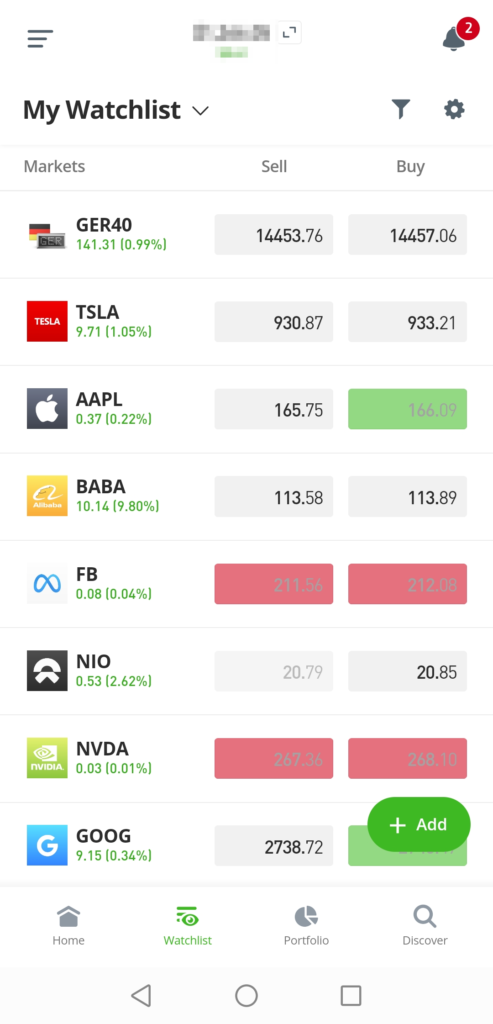
eToro review – Mobile trading platform
At eToro, you can trade CFDs and forex, as well as real stocks, ETFs, many cryptos and options. Innovative services like social trading and Smart Portfolios are also available.
eToro is primarily a CFD and forex broker. However, you can also trade real stocks, ETFs and various cryptos. eToro also has some unique features, such as social trading (CopyTrader) and Smart Portfolios (previously called CopyPortfolios).
If you reside in the United States, you can trade stock, ETF, options and cryptocurrencies.
All non-leveraged long positions in stocks, ETFs and cryptocurrencies are traded as real assets. This means that when you buy equities, ETFs or cryptos without any leverage (i.e. leverage is set to one), you will buy real stocks, ETFs and cryptos and not CFDs.
All other positions are CFDs:
So, does that mean that eToro acts like a traditional stockbroker just with zero commission when you buy stocks? The answer is no, there are some differences.
For example, it is not possible to initiate a stock transfer between eToro and another brokerage (and vice versa). This means that all positions that are opened with eToro must be closed with eToro.
Furthermore, as eToro holds stocks on behalf of its users as beneficial owners, users do not currently have voting rights for stocks held.
However, you are allowed to hold fractional shares.
We do not recommend eToro for long-term investors focusing on collecting dividends from US stocks. This is because eToro deducts the 30% default US dividend tax, rather than the – usually lower – tax treaty rate deducted by most other brokers. Instead, we suggest you check out the best discount brokers.
All of the above seem to suggest that while eToro is great for stock traders, for long-term investors it might not be the best choice. We’re not sure how eToro would handle corporate events (e.g. a spin-off).
Let’s pivot to eToro’s CFD offering. Within CFDs, in addition to the traditional way of trading, you can
To learn more about CFDs, read our CFD trading tips.
Disclaimer: CFDs are complex instruments and come with a high risk of losing money rapidly due to leverage. 79% of retail investor accounts lose money when trading CFDs with this provider. You should consider whether you understand how CFDs work and whether you can afford to take the high risk of losing your money.
eToro offers a wider range of stock and ETF CFDs than its closest competitors. The number of available cryptocurrencies to trade is excellent. Note that scalping is not allowed at eToro.
| eToro | Trading 212 | XTB | |
|---|---|---|---|
| Currency pairs (#) | 49 | 179 | 56 |
| Stock index CFDs (#) | 16 | 35 | 40 |
| Stock CFDs (#) | 2,000 | 1,530 | 1,900 |
| ETF CFDs (#) | 264 | 28 | 140 |
| Commodity CFDs (#) | 24 | 28 | 21 |
| Bond CFDs (#) | – | – | – |
| Cryptos (#) | 76 | – | 25 |
You can change the default leverage level of the products.
Changing the leverage manually is a very useful feature when you want to lower the risk of a trade. For example, instead of trading with 5:1 leverage, trading with only 2:1 leverage in the case of stock CFDs reduces your risk exposure significantly. Be careful with forex and CFD trading, since the pre-set leverage levels are high.
eToro has two distinctive innovations, CopyTrader and Smart Portfolios.
CopyTrader is the so-called social trading feature. What is eToro really good at? Well, this is it! One by one you can copy the portfolio of traders who also trade on eToro. This might be of interest for those who don’t want to manage their own money. You can browse through the profiles of other eToro traders, checking their previous performance on an annual and a monthly level. Their portfolio is public information.
Additionally, eToro also applies a risk score to each trader. There are tons of additional stats for each profile, like trades per week, average holding time, performance on charts, and you can also see their detailed profiles as well as their news feed comments. Imagine Facebook profiles, but with fewer inspirational and more market quotes.
The minimum amount you can invest in one trade is $200. While there is no extra fee for this service, spreads and overnight fees may be applied according to each opened copied position.
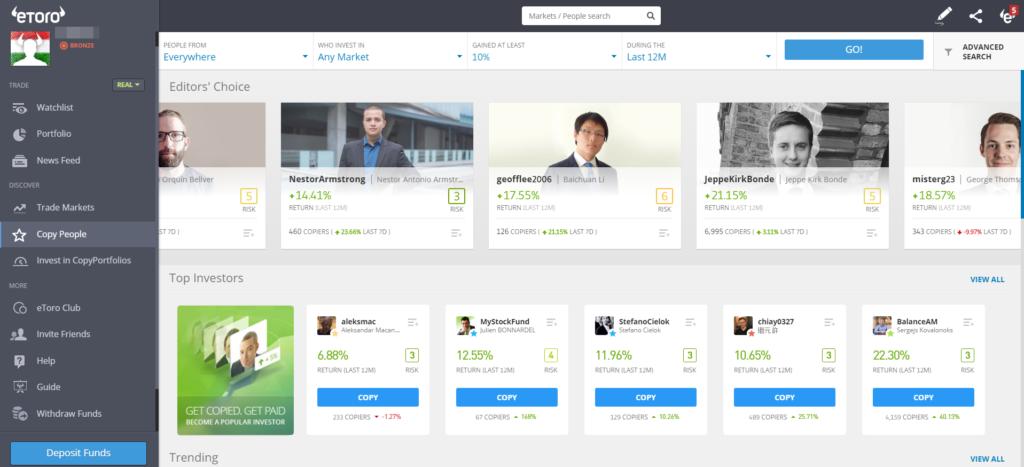
Etoro review – Markets and products – Copy Trading
Disclaimer: Past performance is not an indication of future results. Trading history presented is less than 5 complete years and may not suffice as basis for investment decision.
Copy trading is a portfolio management service, provided by eToro (Europe) Ltd., which is authorized and regulated by the Cyprus Securities and Exchange Commission.
Previously called CopyPortfolios, Smart Portfolios are a grouping of several assets, such as stocks, cryptocurrencies, ETFs, and even people, bundled together based on a predetermined theme or strategy.
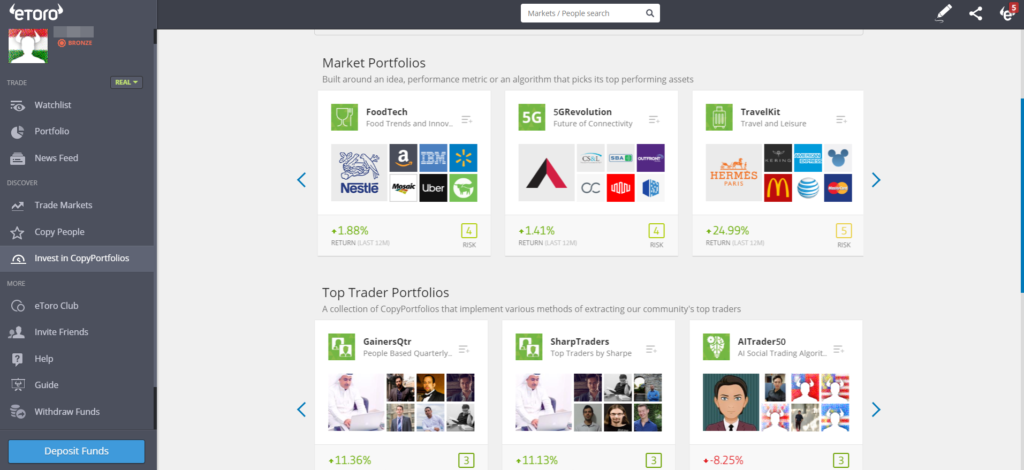
Etoro review – Markets and products – Copy Funds
Disclaimer: Past performance is not an indication of future results. Trading history presented is less than 5 complete years and may not suffice as basis for investment decision.
The proportion of CFDs in the specific Smart Portfolio is clearly indicated. You can check performance and asset distribution, and read the investment strategy. Smart Portfolios are built around a theme by eToro’s algorithms (using machine learning and data science) or by eToro external partners.
This might all sound a bit complicated, but at the end of the day, this means you can invest easily in a quasi-fund. The minimum amount required to invest in Thematic Market and Partner Portfolios is $500, while for Top Trader Portfolios, the minimum is $5,000. eToro also checks your financial knowledge to determine whether Smart Portfolios is right for you.
If you buy stocks or ETFs without leverage, you are buying the real asset, not a CFD. Usually, this feature is not offered by other CFD and forex brokers. In that sense, eToro’s selection of 17 stock markets to access is great. However, compared with stockbrokers like Saxo Bank (about 35 markets) or Interactive Brokers (80), it is poor.
Note that if you’re going short (selling a stock that you don’t already have), you’re always trading a CFD.
| eToro | Trading 212 | XTB | |
|---|---|---|---|
| Stock markets (#) | 17 | 15 | 17 |
| ETFs (#) | 145 | 1,800 | 270 |
At eToro, you have access to the following 17 stock exchanges:
However, you can only trade the more popular stocks. For example, the number of tradable stocks on the Nasdaq with eToro is currently less than 700, which is only around 20% of the listed companies on the Nasdaq exchange.
Why would this matter to you? If you only trade the most popular stocks, like Microsoft or Apple, you probably won’t notice the lack of smaller stocks. eToro will, from time to time, make new stocks available for trading, usually in a batch.
For example, on March 30, 2020 eToro added 185 new stocks, among them a very trending one, Zoom Technologies. However, if you had to wait for eToro to add the stock, you missed the early rally in the stock.
Option trading is only available in the United States at the moment, furthermore it is accessible only trough the eToro Options app.
The app is quite simple, as option trading is the only option. It offers an overview, news and statistics for every asset, also we can find a Feed, where we can use the social trading features.
The number of available options markets is low, however, their competitors, like Trading212 and XTB are not offering options at all.
| eToro | Trading 212 | XTB | |
|---|---|---|---|
| Options markets (#) | 1 | – | – |
This selection is great compared to competing brokers. Both Trading 212 and XTB offer fewer option markets to trade on.
Not only does eToro offer 72 different coins to trade, but you also have the option to trade 14 crypto crosses (like ETH/BTC) and 63 non-USD currency crosses (like LTC/AUD).
eToro offers the following methods to trade and own cryptocurrencies: Crypto CFDs, Spot crypto, Crypto exchange (eToroX) and Crypto wallet.
However, not every method is available in every country. For example, UK residents don’t have access to Crypto CFDs.
The general rule of thumb with eToro is that when you go long in any virtual currency, you will own the real coin. When you go short, it is a CFD.
However, there are some country-specific rules as discussed above. For example, as a US resident, you can only go long on the real coin; trading CFDs and therefore going short on cryptocurrencies is not allowed.
Cryptocurrency prices can fluctuate widely and are therefore not appropriate for all investors. Trading cryptocurrencies is not supervised by any EU regulatory framework, such as MiFID. Therefore, when using eToro’s Cryptocurrencies Trading Service you are not eligible for any investor protection.
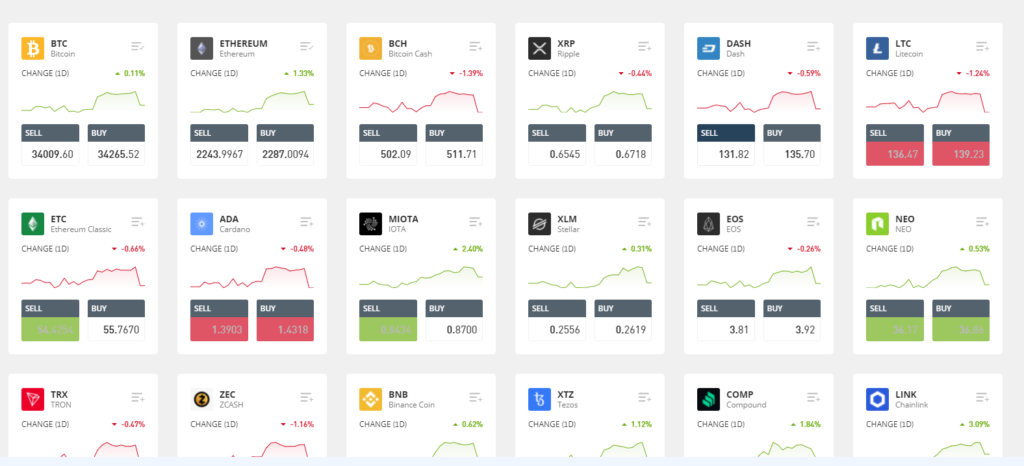
Etoro review – Markets and products – Cryptocurrencies
Disclaimer: Cryptoassets are highly volatile and unregulated in the UK. No consumer protection. Tax on profits may apply.
You can trade a wide variety of cryptocurrencies on eToro. Along with STORJ, BAL, GALA and LRC, traders have access to BTC, ETH, BCH, LTC, XRP, DASH, ETC, ADA, XLM, EOS, NEO, TRON, ZEC, BNB, XTZ, MIOTA LINK, UNI and DOGE. Check the table below for a detailed breakdown and some other minor virtual currencies.
See also our detailed guide on how to buy Bitcoin on eToro.
| Cryptos as real assets (for non-US residents) | Cryptos as CFDs (for non-US residents) | Cryptos as real assets (for US residents) |
|---|---|---|
| AAVE | ADA | AAVE |
| ADA | BCH | ADA |
| ALGO | BNB | ALGO |
| BAL | BTC | BAT |
| BAT | DASH | BCH |
| BCH | DOGE | BTC |
| BNB | COMP | |
| BTC | ETC | DASH |
| COMP | ||
| DASH | ETH | DOGE |
| DOGE | LINK | EOS |
| EOS | LTC | ETC |
| ETC | MIOTA | Ethereum |
| ETH | NEO | LINK |
| GALA | ||
| LINK | TRX | LTC |
| LRC | ||
| LTC | UNI | MANA |
| MANA | XLM | MATIC |
| MATIC | XRP | MIOTA |
| MIOTA | XTZ | NEO |
NEO | ZEC | TRX |
| STORJ | ||
| TRX | UNI | |
| UNI | XLM | |
| XLM | XTZ | |
| XRP | YFI | |
| XTZ | ZEC | |
| YFI | ||
| ZEC |
To dig deeper, read eToro’s CFD description. We would also recommend reading our article on how to invest in Bitcoin.
eToro has good technical analysis tools. There are some analyst recommendations and market sentiment indicators available, but no comprehensive fundamental data.
| Pros | Cons |
|---|---|
| • Good interactive chart | • No fundamental data available |
| • Trading ideas | • No/poor quality news flow |
| • User-friendly | |
| • Analyst recommendations |
Research is available in 21 languages (the same languages that are available on the web and mobile trading platforms).
For some popular stocks, you can find recommendations like analyst consensus (buy/hold/sell), average price target, hedge fund sentiment and insider trading sentiment. In some cases, you can also read the analyst reports. Unfortunately, these research features are available only for a limited number of stocks.
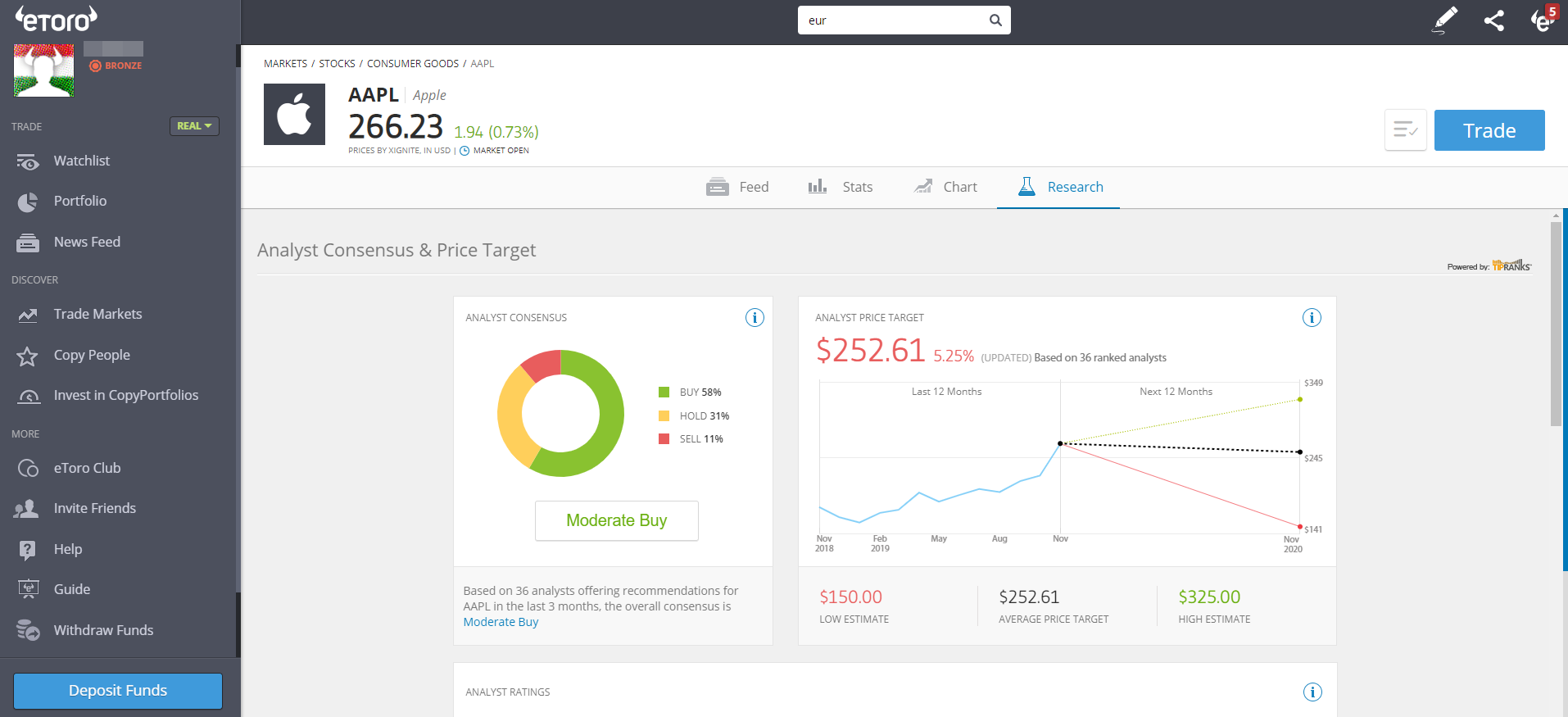
eToro review – Research – Recommendation
Some basic fundamental data on stocks is available on eToro’s platform. This includes the profile of the company and some very basic indicators and ratios such as P/E, EPS, dividend yield and beta. No fundamental data is available for asset classes other than stocks.
You can also sign up for a daily market analysis newsletter, in which you get a useful list of market highlights.
eToro’s charting tool is quite good and you can use many, around 70 technical indicators. We liked that charts are automatically saved, so you don’t have to waste your time setting up your indicators time and again.
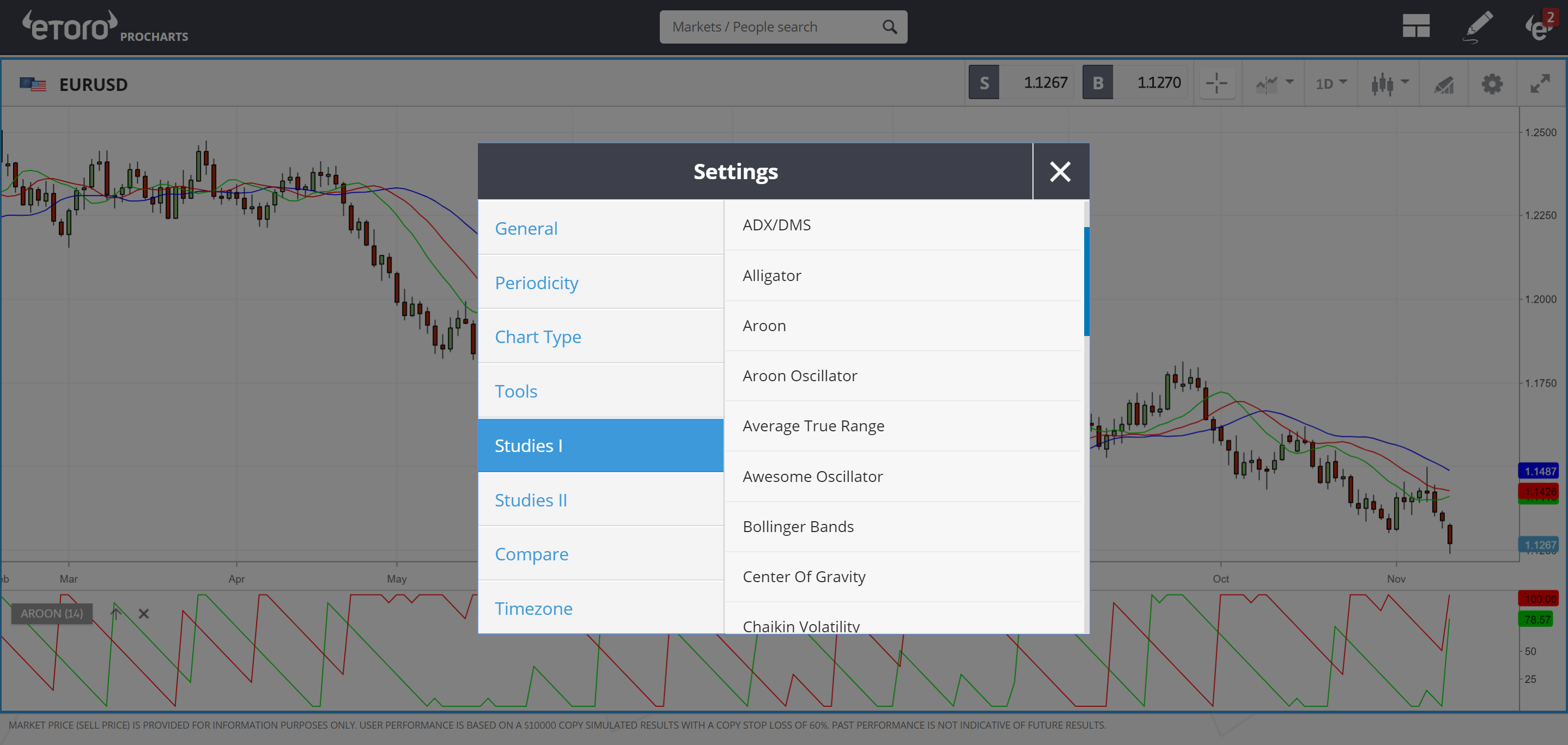
eToro review – Research – Charting
The news feed is not really an official news feed. It is more like a market-themed Twitter feed, showing messages posted by eToro users and analysts. Hashtags (#) are used for themes and dollar signs ($) for assets. We were not a huge fan of this feature, but it certainly adds a social media aspect to trading.
79% of retail CFD accounts lose money
eToro customer service is below average: you can reach them mainly via web-based tickets but it may take a long time to get a response. Live chat is only available for Club members.
| Pros | Cons |
|---|---|
| • Relevant answers | • No phone support |
| • No 24/7 support | |
| • Live chat only for Club members |
eToro customer service, in theory, is available in all 21 languages the web and mobile trading platforms offer. We tested customer service only in English.
You can contact eToro’s customer service via a web-based ticketing system. We got answers usually within 48 hours when we tested it with some basic questions. On the other hand, we received feedback from users that eToro often takes as much as 14 days to respond in more complex cases, which we think is extremely poor service.
Live chat is currently only available for Club members. The lowest tier of eToro Club membership is the silver one, which one can reach by having more than $5,000 in equity on their account.
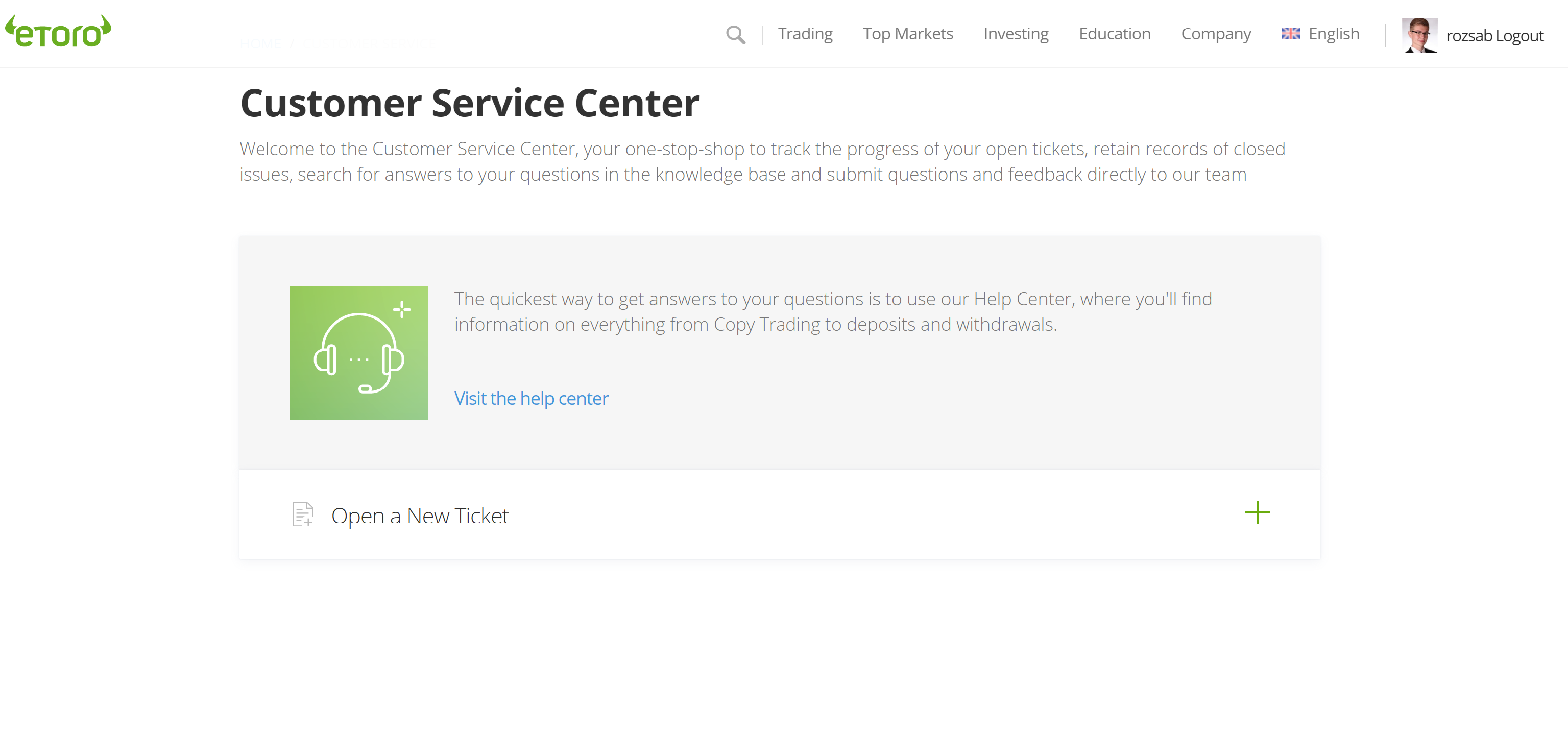
eToro review – Customer Service
eToro has various educational tools available in different formats, but the overall quality is mediocre.
| Pros | Cons |
|---|---|
| • Demo account | • Overall quality could be better |
| • Trading platform tutorial | |
| • Educational videos |
To practice, you can use a demo account.
eToro Academy offers a variety of resources including written guides, videos, webinars and podcasts, as well as in-person and online training courses.
The content discussed is intended for educational purposes only and should not be considered investment advice.
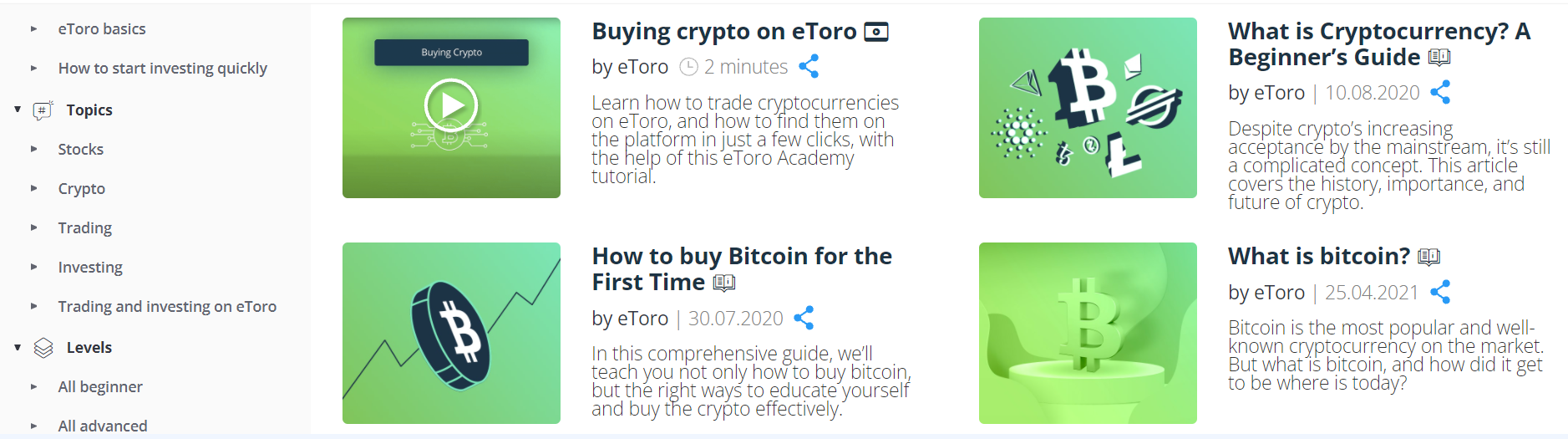
eToro review – Education
eToro is regulated by top-tier financial authorities like the FCA, and ASIC as well as CySEC. However, it is not listed on any stock exchange and does not have a bank parent.
| Pros | Cons |
|---|---|
| • Majority of clients belong to a top-tier financial authority | • Does not hold a banking license |
| • Negative balance protection | • Not listed on stock exchange |
| • Financial information is publicly available |
Yes, it is regulated by the Cyprus Securities and Exchange Commission (CySEC), the UK’s Financial Conduct Authority (FCA), and the Australian Securities and Investment Commission (ASIC).
eToro is based in Israel and was founded in 2007.
To be certain if a brokerage is safe, we highly advise that you check two facts:
eToro operates three legal entities and serves customers based on their residency. This matters because the entity you belong to defines the amount of investor protection you get.
All clients onboarded to these three entities above are eligible for eToro’s private insurance. This is a £/$/€ 1,000,000 insurance for cash, securities and CFDs. It is provided by Lloyd’s and applies in the event of eToro’s insolvency. This is a great addition as not all brokers provide another layer of protection above the regulatory one. Of course, it could be withdrawn by eToro at any time.
Here is a handy summary table for easy comparison:
| Country of clients | Protection amount | Regulator | Legal entity |
|---|---|---|---|
| United Kingdom | £85,000 + £1,000,000 | Financial Conduct Authority (FCA) | eToro (UK) Ltd. |
| Australia | $1,000,000 | Australian Securities and Investments Commission (ASIC) | eToro AUS Capital Pty Ltd. |
| Other countries | €20,000 + €1,000,000 | Cyprus Securities and Exchange Commission (CySEC) | eToro (Europe) Ltd. |
There is no investor protection for cryptos.
eToro also provides negative balance protection for CFD trading, but only for retail clients from the European Union and Australia. Professional clients are not covered with any negative balance protection.
For more details, check eToro’s Regulation and License page.
eToro was established in 2007. The longer track record a broker has, the more proof we have that it has successfully survived previous financial crises. This means that it has already survived one crisis, which is a good sign. eToro is a privately-owned fintech startup, with owners including venture capital funds like Commerz Ventures Gmbh, the VC arm of Commerzbank, as well as Israeli, US and Chinese investors. eToro is led by Yoni Assia, its well-known founder and CEO.
In addition, there is financial information publicly available on the company.
Yes, eToro is considered safe. It is regulated by top-tier financial authorities.
How does eToro work? eToro offers zero-commission stock trading. The account opening is swift and seamless. It has a lot of innovative features, like social trading and copying other (successful) traders. Furthermore, eToro offers many cryptos to trade.
It has some drawbacks, though. There is a $5 withdrawal fee and eToro only allows USD accounts, which means that conversion costs on deposits and withdrawals can be high if your funding currency is not USD. It’s difficult to contact customer support and their educational materials could be better.
So is eToro good? Overall, we would recommend eToro for its social trading feature, crypto offering and zero-commission stock trading. If you are a long-term stock investor, a traditional stockbroker might make more sense to you as some of the drawbacks of eToro (like not applying reduced withholding tax on US dividends) might outweigh the benefits of free trading.
eToro is a multi-asset platform which offers both investing in stocks and cryptoassets, as well as trading CFDs.
Disclaimer: CFDs are complex instruments and come with a high risk of losing money rapidly due to leverage. 79% of retail investor accounts lose money when trading CFDs with this provider. You should consider whether you understand how CFDs work and whether you can afford to take the high risk of losing your money.
Past performance is not an indication of future results. Trading history presented is less than 5 complete years and may not suffice as basis for investment decision.
Copy trading is a portfolio management service, provided by eToro (Europe) Ltd., which is authorized and regulated by the Cyprus Securities and Exchange Commission.
Cryptoasset investing is highly volatile and unregulated in some EU countries. No consumer protection. Tax on profits may apply.
eToro USA LLC does not offer CFDs and makes no representation and assumes no liability as to the accuracy or completeness of the content of this publication, which has been prepared by our partner utilizing publicly available non-entity specific information about eToro.
Although eToro does not make its financial statements public, the main source of revenue for eToro is likely to be:
79% of retail CFD accounts lose money
eToro is primarily a CFD and forex broker, but you can also trade real stocks, ETFs and many cryptocurrencies on its platform. It is well-known for its social trading feature, which allows you to follow and copy the portfolio of any trader in the eToro network.
At the time of writing this review, eToro was a privately held company and as such not required to publish its ownership structure. What we know is that eToro does not have any banking parent company (little chance for a bailout in case of bankruptcy). The well-known founder and CEO of eToro is Yoni Assia.
eToro is funded by venture capitalists. Here are a few of them:
eToro is regulated by financial authorities in Cyprus, the UK and Australia. eToro operates the following legal entities:
eToro makes money by collecting various fees and the trading services it provides on its website. Although eToro does not make its financial statements public, the main sources of revenue for eToro are likely:
eToro is regulated by CySEC in Cyprus, ASIC in Australia, and the FCA in the UK. This is a good thing. eToro is not listed on any stock exchange, nor does it publish its financial data. Overall, TradingBrokersView’s view is that while eToro is not a scam, it is not a fully transparent broker either.
eToro copy, a.k.a. CopyTrader, is a social trading tool. When you use Copay Trader, you copy the trades of other people or other people copy your trades. You can search for traders and other users in the eToro network and check how their portfolio performed historically. When you find a trader you like, you can copy their trades automatically. You can decide how much money you want to invest in copying another trader, and you can close your positions whenever you wish. You can also make money by having other traders copy you.
Any profit realized by trading on eToro can be subject to taxation laws and regulations. This depends on the country of your residence. For further information about eToro and taxes, we recommend you contact your local tax authority.
Currently, people from the USA cannot use all services and features provided by eToro because US regulations do not allow trading in CFD instruments (eToro is a CFD broker) for US residents. As a result, no regulated broker will allow retail clients in the US to trade CFDs. US clients can trade crypto, real stocks and ETFs on eToro.
eToro is not available to the residents of the following countries:
At eToro, you can trade CFDs, which are complex instruments and carry a high level of risk. Many retail traders can lose their invested money and may even owe funds if their trade goes wrong. That may happen because trading CFDs involves leverage or borrowing capital. Some 68% of retail investor accounts lose money when trading CFDs with eToro.
eToro has its pros and cons: they provide free stock and ETF trading, a seamless account opening process, and a superb social trading platform. We chose eToro as the best social trading broker and the best broker for cryptos. However, their non-trading fees are high.
eToro offers free stock and ETF trading, while forex and CFD fees are low. On the negative side, non-trading fees are high, including a $5 withdrawal fee. The minimum deposit in EEA countries is $50, while it’s $10 in the US and UK.
eToro is a highly regulated broker that is overseen by several top-tier authorities, such as the FCA in the UK, Cysec in Cyprus and ASIC in Australia. Multiple regulation adds a high level of security to eToro. Clients trading with eToro’s FCA and CySec-regulated entities are entitled to investor protection. In addition, eToro provides private insurance to its customers accepted under these three regulators. Client’s cash funds deposited into their eToro account are held in regulated and licensed US banks and are FDIC-insured up to $250,000. Personal data is kept under SSL encryption.
If you trade stock CFDs on eToro, you will not own the underlying stocks. CFDs are clearly marked on eToro’s trading platform. Except for US clients, eToro customers can also trade real stocks (if they select the option to trade without leverage), in which case they will own the stock in question.
eToro charges a $5 fee to withdraw funds from your trading account. As only USD accounts are available at eToro, you will need to pay a high conversion fee if you deposit or withdraw in a currency other than USD.
eToro is a well-known Israel multinational social trading platform and fintech company, focusing on copy trading and financial services. It has registered offices in the United Kingdom, Australia, the United States and Cyprus. eToro serves UK clients through a unit regulated by the FCA, Australians through an ASIC-regulated entity, and all other customers are served by a legal unit under CySEC supervision. US customers trade with an eToro unit regulated by SEC and FINRA.
Withdrawal times at eToro depend on the withdrawal method. For us, a bank withdrawal took 2 business days. Most payment providers, such as e-wallets, take 1-2 business days. A wire transfer typically takes 3-8 business days at most.
Our best alternatives and highest ranking competitors to eToro are:
These brokers are comparable in terms of the products they offer (i.e. stocks, CFDs, crypto, etc.) and the type of clients they target ( i.e. beginners, experienced investors, or day traders).
In the comprehensive collection below, you can find links to all aspects of eToro.
We detailed this in our eToro fees article.
Our ultimate guide to the eToro minimum deposit is updated regularly.
Look no further than our evaluation of the eToro account opening.
Here’s our expert view after checking the eToro trading app.
All you need to know about the eToro customer service.
Is eToro legit features all the key aspects you need to look at to see if a broker is safe and legit.
A glance at actual costs and whether eToro is really free.
We checked it in Is eToro good for beginners.
Research for silver bugs in the Silver buy on eToro guide
We explored the topic in Can you trade options on eToro?
->Back to eToro review

Compare broker tool
Compare selected brokers by their fees, minimum deposit, withdrawal, account opening and other areas. Filter according to broker or product type, including stocks, futures, CFDs or crypto.
Not sure which broker to choose?
For a tailored recommendation, check out our broker finder tool. Answer 4 simple questions and get a list of the most relevant brokers. & FMB button.
Compare broker tool
Compare selected brokers by their fees, minimum deposit, withdrawal, account opening and other areas. Filter according to broker or product type, including stocks, futures, CFDs or crypto.
