How We Evaluated Fees
We assessed OANDA’s fee levels by categorizing them as low, average, or high, based on how they compare with the pricing of all brokers we reviewed.
To start, it’s useful to understand the two main types of broker costs you should monitor: trading fees and non-trading fees.
Trading fees are incurred when you place trades and may include spreads, commissions, financing (overnight) charges, and currency conversion costs.
Non-trading fees cover expenses not directly linked to trading activity, such as withdrawal charges or inactivity fees.
In the sections below, we highlight OANDA’s most relevant costs across each asset class. For example, when trading forex or stock index CFDs, spreads, commissions (if any), and financing rates are typically the key factors.
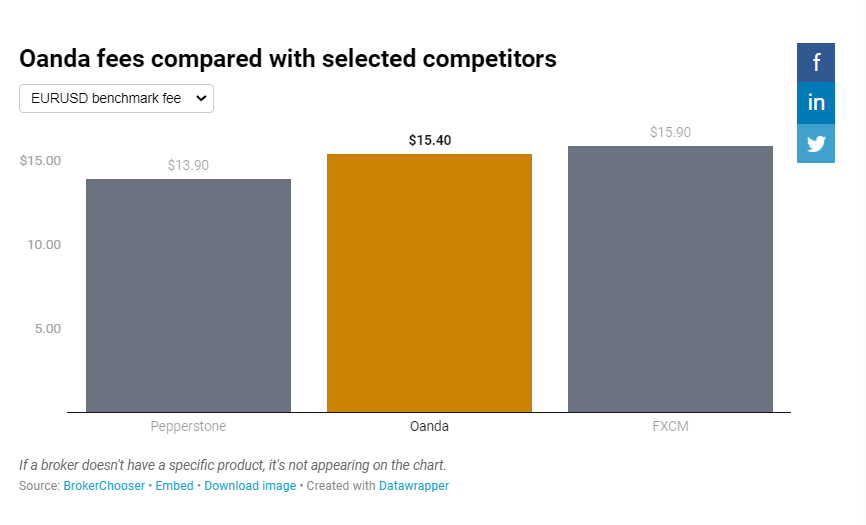
To put OANDA’s pricing into context, we also compared its fees with those of similar brokers, including Pepperstone and FXCM. These peers were selected based on objective criteria such as available products, target clients, and overall fee structures.
To get a clear picture, let’s begin with trading costs.
OANDA Trading Fees
OANDA generally offers low trading fees. Instead of charging commissions on most trades, the broker primarily applies costs through spreads. However, an inactivity fee is charged if an account remains unused for more than one year.
Because forex pricing can be difficult to compare directly, we evaluated total trading costs by calculating all fees involved in a typical trade for selected instruments.
We focused on commonly traded products across each asset class:
Forex: EUR/USD, GBP/USD, AUD/USD, EUR/CHF, EUR/GBP
Stock index CFDs: S&P 500 (SPX) and Euro Stoxx 50 (EUSTX50)
A “typical trade” was defined as opening a position, holding it for one week, and then closing it. For trade size, we assumed a $20,000 position for forex pairs and a $2,000 position for stock index CFDs.
OANDA Leverage and Margin Requirements
Available leverage depends on the client’s country of residence. For instance, US-based traders can access leverage of up to 50:1, while clients in the European Union are limited to a maximum of 30:1.
OANDA Financing (Interest) Rates
Positions held overnight incur financing costs, also known as swap or rollover rates. These rates depend on several factors, including daily interest rates, position size, the instrument traded, and prevailing funding conditions.
At OANDA, overnight financing charges typically range between -6% and 2%, although they fluctuate daily and can occasionally fall outside this range.
Forex Fees
OANDA’s forex trading costs are generally low and competitive, closely matching those of its main peers for most major and minor currency pairs.