


The IPO market has only grown hotter and more digital in the wake of the pandemic. A slate of newly listed companies have been celebrating virtual bell ringing ceremonies after virtual roadshows and video meetings with prospective investors since the spring of 2020.
The market boom is powered by investor demand for new offerings, as well as ample liquidity. Investor appetite for young growth firms seems insatiable as nobody wants to miss out on the next Amazon or Facebook. The dramatic price increases seen after some recent high-profile IPOs have only further boosted demand. This trend looks likely to continue in 2021, especially if global central banks keep their easy money policy.
But that doesn’t mean that IPOs are always good investments. They don’t guarantee huge profits at little risk. If you want to invest in an IPO make sure, as always, that you are well-informed as these offerings are considered risky and speculative investments. These stocks lack a trading history, a track record of reporting to investors and research coverage.
What is an IPO, then? IPO stands for initial public offering. It is a transaction when a private company offers its shares to the public for the first time in a new stock issuance. The company is “going public,” which means that its private ownership becomes public and its shares will be listed and traded on a stock exchange.
Why would a private company choose to go public? The main reasons are to raise funds to finance its expansion, to provide an exit for early investors, such as venture capital firms and angel investors, and to increase visibility.
2020 was a banner year for IPOs. The IPO market reached a new record high in 2020 with the number of listings on the US stock market more than doubling, driven by the health care and tech sectors. According to Stock Analysis, there were 481 IPOs last year, compared to 233 deals in 2019. This is 20% higher than the previous record of 2000, which saw 397 offerings.
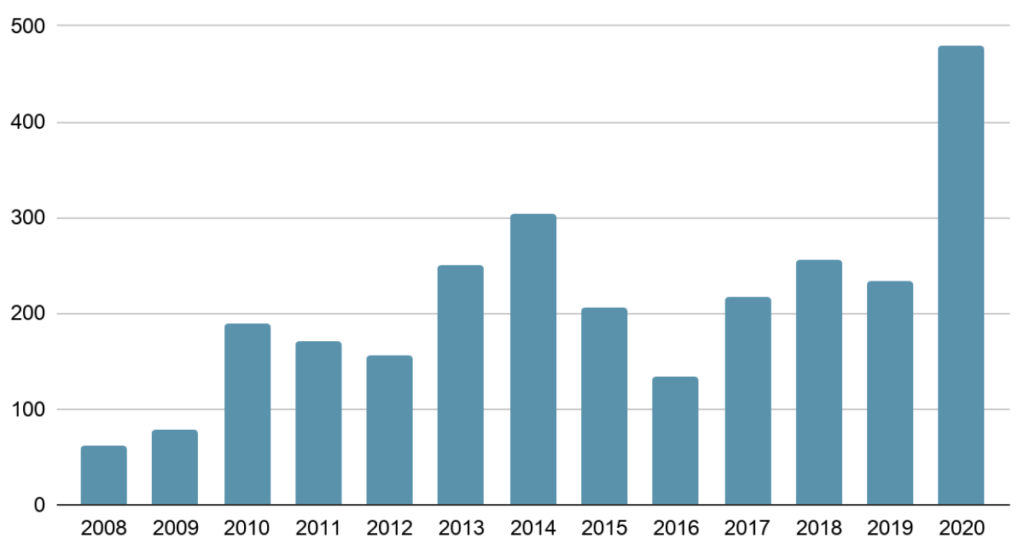
The year 2020 marked a major shift in how companies enter public markets, with alternative routes gaining strong momentum. Beyond traditional IPOs, businesses increasingly turned to options like direct listings and SPACs to raise capital or go public more efficiently.
A direct listing allows existing shares of a company to be sold directly to the public without issuing new shares or involving underwriters. This means the company does not raise fresh capital—instead, current shareholders sell their holdings directly on the market.
Unlike traditional IPOs, where investment banks allocate shares primarily to institutional investors, direct listings provide equal access to both institutional and retail participants, with no allocation process involved.
In a standard IPO, investment banks play a central role by underwriting the offering, purchasing shares from the company, and distributing them to investors. They also help determine the initial pricing.
Direct listings eliminate key IPO elements such as bookbuilding (gauging investor demand) and roadshows (presentations to potential investors). While this significantly reduces costs, it also introduces higher uncertainty around pricing and demand.
Another advantage is the absence of lock-up periods, allowing insiders to sell shares immediately after listing.
Well-known examples of companies that went public through direct listings include Spotify and Slack, both of which are listed on the New York Stock Exchange.
SPACs are publicly traded shell companies created specifically to raise funds through an IPO and later acquire a private business. The capital raised is held in trust and can only be used for a merger or acquisition.
These entities have no operations of their own—they exist purely to take another company public through a merger.
SPAC investors can include private equity firms, high-net-worth individuals, and retail investors. In 2020, SPAC activity surged dramatically, with hundreds of deals raising hundreds of billions of dollars.
Their growing popularity stems from several advantages:
Faster and more streamlined process compared to traditional IPOs
Greater pricing transparency through negotiated valuations
Fewer regulatory and procedural hurdles
A notable example is Pershing Square Tontine Holdings, launched by Bill Ackman. It raised $4 billion by selling 200 million shares in July 2020 and was given two years to acquire a private company, with a focus on mature, high-quality businesses.
Alongside these alternative methods, “unicorn” companies—privately held firms valued at over $1 billion—have dominated IPO headlines.
Recent examples include DoorDash and Airbnb, both of which successfully transitioned to public markets.
To measure the performance of newly listed companies, investors often look at the Renaissance IPO Index. This index tracks the largest and most liquid U.S.-listed recent IPOs.
Key characteristics of the index include:
Covers the top 80% of newly public companies by market capitalization
Weighted by free-float market cap
Caps individual holdings at 10%
Removes companies after two years of public trading
Notably, the index more than doubled in 2020, reflecting the strong momentum in the IPO market during that period.
| Saxo Bank | Fusion Markets | CMC Markets | Interactive Brokers | Capital.com | |
|---|---|---|---|---|---|
| EURUSD spread | 0.8 | 0.0 | 0.7 | 0.1 | 0.6 |
| GBPUSD spread | 1.3 | 0.2 | 0.9 | 0.3 | 1.3 |
| AUDUSD spread | 0.8 | 0.0 | 0.7 | 0.1 | 0.6 |
| EURCHF spread | 1.4 | 0.6 | 2.5 | 0.4 | 2.2 |
| EURGBP spread | 1.4 | 0.3 | 1.1 | 0.2 | 1.5 |
If you are a retail investor, it is difficult to directly participate in an IPO and buy the shares at the offering price. This is because the underwriters normally sell the majority of the new shares to institutional investors, such as mutual funds, pension funds or hedge funds. The remaining shares are sometimes sold to high-net-worth individuals. Retail investors typically comprise only a very small share of IPO buyers.
If you decide to try to directly invest in an IPO, first you need to find a company that is about to go public. If you want to track upcoming offerings, check the IPO calendars of major stock exchanges. The NASDAQ and the NYSE provide information about both the latest and the expected upcoming deals. Although you’ll find the most reliable information here, you should also check websites such as Google News and Yahoo Finance, to stay informed about all IPOs, not only about the issues that will be listed on these two exchanges.
Once you find an attractive upcoming offering, you have to submit an application to your broker for participating in the IPO and state the number of shares you want to buy. Mind you, this doesn’t mean that you get them. You may receive some, all or none of the shares you requested. Not much help, right? Due to these uncertainties, retail investors usually buy the new shares on the open market via their broker in the days following the offering.
Also, let’s not forget that attempts at an IPO can fail. Remember when co-working company WeWork pulled its offering in 2019 after the SEC raised serious concerns about the transaction? And that wasn’t the end of the company’s misfortunes. CEO Adam Neumann soon stepped down under pressure and the company was taken over by Japan’s SoftBank Group in a rescue deal.
If you don’t want to bother following the IPO market and you’re struggling with individual stock selection, you can always invest in IPO funds and ETFs through your broker. These are professionally managed and highly diversified portfolios. Moreover, you’ll get exposure to the new issuers before they get included in the main US equity indexes.
If you get the chance to invest in an IPO, read the prospectus first! This is the offering document in the registration statement, which will help you decide if the IPO is a good investment for you. A registration statement is a set of documents that a company has to file with the US Securities and Exchange Commission (SEC) before it proceeds with an IPO.
Issuers use the prospectus to inform investors about the company and the terms of the IPO. Where can you find the prospectus? It is publicly available in the company’s registration statement on the SEC’s EDGAR database. EDGAR stands for Electronic Data Gathering, Analysis, and Retrieval system. Access to EDGAR’s public database is free.
We recommend that you also read the preliminary prospectus, the so-called “red herring”. The somewhat strange name derives from the disclaimer in red on the cover page of the document saying that the registration statement has been filed with the SEC, but is not yet effective. The preliminary prospectus lacks key information, such as the price and the number of shares to be offered.
Make sure that you read the latest version of the offering document too, because the prospectus is usually updated several times during the registration process. You might want to pay attention to the changes made from the “red herring.”
The main sections of a prospectus are:
Source: SEC
After reading the prospectus, check as many independent sources as possible to verify the information provided by the issuer.
The underwriters recommend a price to the issuer based on the valuation of the company and on the preliminary interest of potential investors. The process by which the offering price is determined is called bookbuilding. The order book lists how many shares each investor would like to purchase and at what price. The final offering price is set by the issuer.
If you look at recent transactions you can see that some offerings were massively mispriced despite all that valuation and bookbuilding work. Why?
IPOs can be overpriced because
Or underpriced, as
After the IPO, the stock will start trading publicly on the so-called secondary market. Remember that the trading price of new shares can differ widely from the offering price! So don’t be surprised if share prices are way below or above the offering price.
The initial trading is like a roller coaster. Expect dramatic price swings during the first days of trading. That kind of volatility makes buying the new shares immediately after the IPO risky.
Let’s take a look at a few recent examples of aftermarket performance, i.e. how stock prices moved after an IPO.
Home-sharing platform Airbnb is a great example of lucrative first trading days. The offering price of $68 per share more than doubled on its debut to the stock exchange on December 10, 2020. The share price dropped a bit later, but remained well above the offering price. The Airbnb IPO was expected earlier but was delayed due to the initial impact of the coronavirus pandemic to the company.
Security software company McAfee priced its IPO at $20 per share, but the shares closed below the offering price on the first day of trading on October 22, 2020 and remained there for months.
Underwriters often support the price of the new shares in the first days of trading to avoid short-term price fluctuations. Once this support ends, prices may drop sharply.
The underwriters of a company’s shares may exercise a so-called greenshoe option. This is an option to sell additional shares within 30 days of the offering, mainly if demand for the shares is higher than expected. This overallotment option can also be used as a price-stabilization strategy
The limited supply of shares is often the main reason why trading prices soar, especially after the most hyped-up IPOs. Why is the trading volume limited? There might be restricted shares when, for instance, existing shareholders have a lock-up agreement. That means that they can’t sell their shares for a certain period, typically for 180 days. In most offerings, companies sell only a fraction of their shares, with the remaining securities becoming available only six or so months later because of the lockups.
Besides these restrictions, underwrites often discourage “flipping”, when investors who want to make quick profits try to immediately resell the shares acquired in the IPO on the open market. This can further limit trading volumes.
Always check the market overhang in the prospectus. This is the number of shares that are not available for trading at the time of the IPO, but only after it. This could drive prices down.
It may be wise to wait and let stock prices settle after the first tumultuous trading days.
2021 is shaping up to be another strong year in the IPO market as the pipeline for IPOs, direct listings and SPACs remains strong. IPOs continue to be driven by the high level of liquidity on the market that has to be invested. The sectors that are expected to see the most listings are health care, especially the biotech subsector, technology and renewable energy, as these have the biggest potential to thrive in the current environment.
Virtual IPOs and roadshows are probably here to stay even after the pandemic finally ends. They have certain advantages as they make the whole process leaner, shorter and less expensive. In addition, virtual roadshows allow smaller mutual funds outside of key US cities to get access to more prospective issuers and IPOs. Once the worst is over, there will likely be a shift towards a combination of virtual and in-person meetings with investors.
Although they won’t replace traditional IPOs, the alternative ways of listing, such as direct listings and SPACs, are expected to continue to gain popularity. Moreover, SPACs that have already gone public are now searching for deals, which could also drive more private businesses to public markets.

Compare broker tool
Compare selected brokers by their fees, minimum deposit, withdrawal, account opening and other areas. Filter according to broker or product type, including stocks, futures, CFDs or crypto.
Not sure which broker to choose?
For a tailored recommendation, check out our broker finder tool. Answer 4 simple questions and get a list of the most relevant brokers. & FMB button.
Compare broker tool
Compare selected brokers by their fees, minimum deposit, withdrawal, account opening and other areas. Filter according to broker or product type, including stocks, futures, CFDs or crypto.