

So you’ve saved up some money! Rather than let it lie around you decided you want to grow your savings by investing in stocks. We are here to help you get started!
There are many ways to benefit from a rising stock market. Do you want to invest in household names like Microsoft, or speculate in rising stars like Tesla, or invest in gold? All of these avenues, we are going to cover in this article.
This 5-step guide will help you get on the right track:
Now, let’s look at each step in more detail.
The first step before you make stock investments should be making a plan, which involves several basic questions you should think about.
The three main factors you need to consider before investing in stocks are:
Knowing the answers to these questions will put you on the right path to invest in stocks. It will help define which kinds of stocks are the best fit for you based on your investment goals, time commitment, and risk profile, or whether stocks are for you at all.
Last, let’s look at whether stocks are the right investment for you, or if you should focus on other types of products.
Regarding risk, a good rule of thumb to follow is: If your stocks are down 20% in a week, how badly would that affect you? If that’s too much and you think you can’t handle it, then stay away from stocks and invest in some less risky assets, such as short-term U.S. government bonds, for example. If, however, you would be OK with this short-term loss in the hope of long-term gains, then go ahead, stocks might be right for you.
Minimize Risk: If you put all of your savings in just one company, and the company you selected goes bust, you could lose all your invested money.
How to manage it: Diversify your investment portfolio. Practically, it means buying many different stocks so all your eggs are not in one basket. The ideal number of stocks in a portfolio ranges between 5 to 30.
Alternatively, you can also invest in ETFs or mutual funds, which are a simple form of diversification. Read more about ETFs here.
Another popular method to decrease risk in your portfolio is to invest in gold along with regular stocks.
Once you’ve decided how you want to invest in stocks, the next step is opening an account with a brokerage firm. But with so many options available—ranging from traditional firms with physical offices to fully digital platforms—choosing the right one can feel overwhelming.
Each broker comes with its own set of advantages and limitations. They can differ significantly in terms of:
Fee structures
Available markets and products
Trading platforms and tools
Research and educational resources
Because of these differences, it’s important to evaluate brokers based on your personal investing style and goals. Taking the time to compare features can help you avoid unnecessary costs and find a platform that truly fits your needs.
One effective way to narrow down your choices is by identifying your preferences—such as trading frequency, budget, and desired tools—and using that as a filter when comparing brokers.
It’s also important to focus on safety. Choosing a broker that is regulated by reputable financial authorities ensures a higher level of protection and reduces the risk of fraud.
Risk: The online investing space includes many unreliable “brokers” that aim to deceive investors. If you encounter advertisements promoting binary options or automated trading systems promising exceptionally high returns, treat them with caution. These are often warning signs of scams.
How to manage it: When investing online, stick with well-established and regulated brokers that have been tested and verified. Choosing trusted platforms with a proven track record can significantly reduce your risk and provide a safer investing experience.
Once you’ve selected the right broker for you, you need to open an account. This account will handle all your money, as well as all of your investments, such as stocks, funds, bonds, etc. The account opening can usually be done online and may take anywhere from a day to several days. You will also need to fill out various identification forms, so have your documents ready. You can have a look at the best brokers in your country which we carefully selected for you.
After opening your account, in order to start investing in stocks, you will need to deposit money into the account. This process is referred to as funding your account. Depending on the broker, this funding can be done via bank transfer, credit card, or electronic wallets like Paypal or Apple Pay. Some brokers have a minimum amount that you have to deposit to start trading, so keep this in mind when making the transfer.
Many online brokers offer demo accounts, where you can try buying and selling stocks works, without risking any of your actual money. These accounts and trading platforms look the same as the live ones, but no actual transactions are carried out on the open market – the deals are virtual. It’s a useful tool for getting the hang of stock trading before jumping into the market with your hard-earned savings.
To learn more about broker deposits and compare brokers, follow the link below:
With your investment strategy ready, and your account opened and funded, all you need to do now is buy the stock or stocks that you have selected. Trading platforms usually have a search function to help you with this process. Taking into account how much money you have and the price of the product, enter how many shares you want to purchase and press ‘Buy.’ Congratulations! You have now made your first investment and are the proud owner of the stock.
When placing an order, you can choose from different order types. A market order buys immediately at the current market price, while a limit order allows you to specify the exact price at which you want to buy the shares.
Feel free to take a look at how to invest in stocks taking your country residence in mind here.
Perhaps, you would like to take look at the best brokers in your country which we collected for you.
Risk: when buying individual stocks, there is always a risk of selecting the wrong ones. This could mean anything from a company that inflates its potential, actually defaults (goes bankrupt), or buying overpriced stock accidentally.
How to manage this risk
After the initial purchase is done, you can start building or changing your portfolio by selling in order to reap the profits (or cut losses) or buying new product. This is called portfolio management and is usually a necessary part of investing. Although it is possible to buy just once, lie back, and hope that you made the right choices to become a millionaire when you retire, it is not the general experience. For short-term buyers, position management could mean setting up the stop-loss price of where to cut losses and the target price of where you want to sell the shares with a profit.
A good investor keeps an eye on market movements, how economies are doing, which sectors are booming and which are struggling. All this information allows him or her to adjusts their strategy, and make investment decisions accordingly.
Even if you are a long-term investor, you should review your assets a couple of times a year at least. If satisfied, then you can leave things as they are, but if you want to make changes you should. If you are unsure, don’t be afraid to ask for advice, either from an advisor at your online broker. You could do the research yourself by watching online videos or educating yourself via investment courses.
Now that you have passed our investing in stocks 101 courses and mastered the 5-step guide, take a moment to look at the top 5 brokers we chose for you.
If you’re a beginner just starting to explore how to invest in stocks online, we recommend that you choose one of the following five brokers. We tested all five, and we have live accounts with all of them:
When recommending an online broker, we take into account the broker’s fees, trading platform, accessible markets to trade, and how easy it is to open an account.
Safety is also very important, but since we recommend only safe brokers, you don’t have to worry about security. In our recommendation below, we considered the broker’s geographical coverage as well, so you will find some brokers that are more US-focused, some that are more active in Europe, as well as ones that are global players.
| Saxo Bank | Fusion Markets | CMC Markets | Interactive Brokers | Capital.com | |
|---|---|---|---|---|---|
| EURUSD spread | 0.8 | 0.0 | 0.7 | 0.1 | 0.6 |
| GBPUSD spread | 1.3 | 0.2 | 0.9 | 0.3 | 1.3 |
| AUDUSD spread | 0.8 | 0.0 | 0.7 | 0.1 | 0.6 |
| EURCHF spread | 1.4 | 0.6 | 2.5 | 0.4 | 2.2 |
| EURGBP spread | 1.4 | 0.3 | 1.1 | 0.2 | 1.5 |
Due to local market regulations or the coverage offered by brokers, not all services of all online brokers are available in every country. For online brokers that are definitely available in your country, check out our broker finder. If fees are at the top of your agenda, you will also enjoy digging into TradingBrokersView’s ultimate brokerage comparison table.
DEGIRO is a trending Dutch online discount broker. It is privately owned and was established in 2013 by former employees of another brokerage company. DEGIRO is considered safe as it is regulated by top-tier financial regulators, the Dutch AFM and DNB.
Interactive Brokers , one of the biggest US-based discount brokers, was founded in 1978. The broker is regulated by several financial authorities globally, including top-tier ones like the UK’s Financial Conduct Authority (FCA) and the US Securities and Exchange Commission (SEC). Given that the broker has licenses from multiple top-tier regulators, Interactive Brokers is considered safe.
Trading 212 is a global CFD broker but clients can also trade stocks and ETFs free of charge. The company was founded in 2004 and is now headquartered in London. Trading 212 is regulated by the UK Financial Conduct Authority (FCA), the Cypriot Cyprus Securities and Exchange Commission (CySEC), and the Bulgarian Financial Supervision Commission (FSC).
TradeStation Global is a brand of TradeStation International Ltd, which is based in the UK and is regulated by the top-tier Financial Conduct Authority (FCA). TradeStation Global is a combined product offered by Interactive Brokers (IB) and TradeStation for clients outside the EU/EEA.
Fidelity is a US stockbroker founded in 1946. It is regulated by top-tier authorities like the Securities and Exchange Commission (SEC) and the Financial Industry Regulatory Authority (FINRA). Fidelity provides commission-free US stock and ETF trading.
In summary, stocks are excellent investments, especially in the long term. It is worth learning more about the process before diving into it, for which we have assembled a shortlist of easy-to-follow steps.
Follow these simple steps to learn more about how to invest in stocks:
If you follow these guidelines, you will find the process much easier and realize that it is not so scary at all. Start right now, just take the first step and try it out yourself. Welcome to the world of investing!
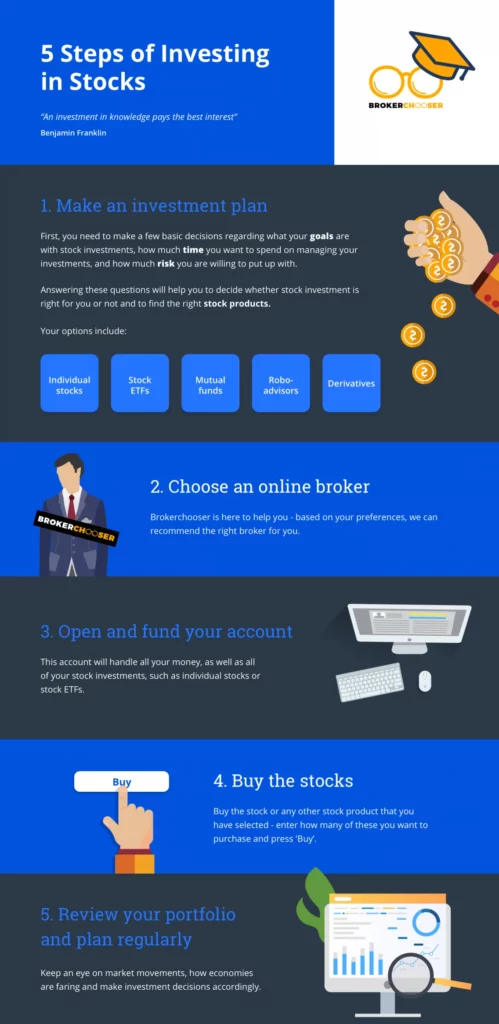
5 Steps to Get Started with Investing on the Stock Market

Compare broker tool
Compare selected brokers by their fees, minimum deposit, withdrawal, account opening and other areas. Filter according to broker or product type, including stocks, futures, CFDs or crypto.
Not sure which broker to choose?
For a tailored recommendation, check out our broker finder tool. Answer 4 simple questions and get a list of the most relevant brokers. & FMB button.
Compare broker tool
Compare selected brokers by their fees, minimum deposit, withdrawal, account opening and other areas. Filter according to broker or product type, including stocks, futures, CFDs or crypto.